

Offsite is playing a growing role in retail media, with brands and retailers keenly eyeing how to use retailer first-party data to leverage the reach of third-party sites, particularly social media, CTV and even podcasts.
The RetailX Offsite Data Workbench report in association with Koddi has taken survey data of 126 US marketers to assess how they use offsite – and how that use will change. Here we take a look at how advertisers approaching offsite, which channels are key and what questions does that raise for retailers and retail media networks as a result?
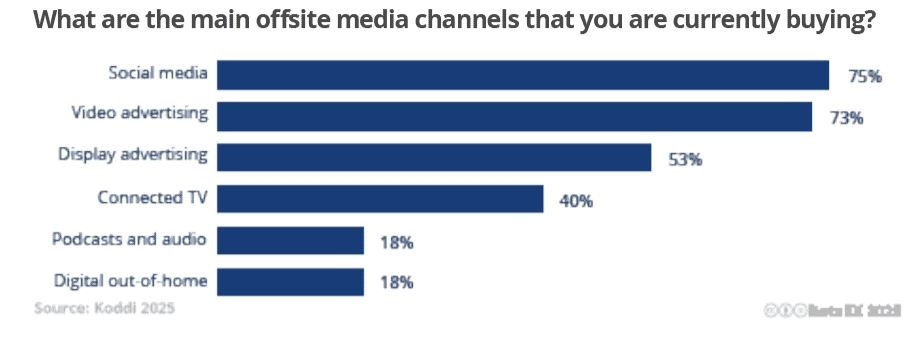
According to the study, the channels that the buy-side consider most important are as you’d expect. However, while social media leads the way, CTV and video are playing a rapidly evolving role.
Social media is key – Social remains the dominant offsite retail media channel, accounting for 75% of buy-side. It suggests retailers and advertisers see it as the most cost-effective way to reach audiences and drive both upper-funnel awareness and lower-funnel conversions. It is also driven by Meta, TikTok and Instagram’s ad ecosystems being established, easy
to use and highly competitive.
Video richness – Video advertising is also highly potent, with rich, visual storytelling underpinning the format. Programmatic video – both long and short-form – drives the market and signals a shift towards content-driven engagement rather than pure display ads. Together with social, video as an offsite channel it also shows that consumers want more than just brand messaging and see entertainment as important in product choice.
Display advertising – Programmatic display ads are grew 14% in 2024, according to eMarketer and display advertising remains relatively popular on the offsite buy-side with 53% still using it as a major marketing tool as it still has reach.
Connected TV – CTV makes a relatively high showing at 40%, indicating that retailers and brands are embracing streaming platforms for targeted video campaigns. This reflects growing fragmentation of TV audiences and the need to meet consumers on platforms such as Netflix (with ads), Hulu and Amazon’s Prime Video.
Podcasts and audio – These services remain niche ad channels, but WARC data shows them growing by 7.9% since 2024. Despite attribution issues, the 18% of our sample buying there points to advertisers experimenting with immersive, longer-form storytelling via podcasts and audio ads on Spotify et al.
DOOH – This shows relatively low but emerging adoption, potentially tied to urban audiences and it being used as part of wider omnichannel strategies. DOOH could become more important for integrating online and offline campaigns, especially in retail-heavy locations such as malls.
Strategic implications
So what does this all mean? The data shows that video (73%) and CTV (40%) adoption points to retail media moving beyond static ads into engaging, story-driven experiences.
Podcasts, audio and DOOH adoption rates are low, which presents opportunities for early moving retail media networks to stand out where competition is light.
The varying adoption rates hint that advertisers are still working out which offsite channels deliver measurable conversions and how to tie offsite impressions back to retail outcomes – retailers need to work on this.
Which channels do you expect to spend more on in retail media over the next 12 months?
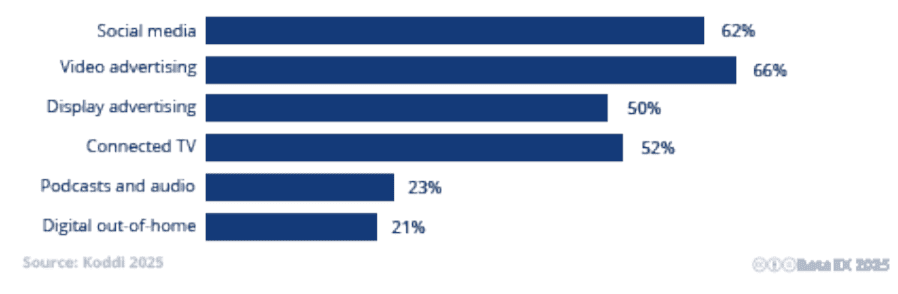
So, how is that use of offsite set to change in the coming year and what does that mean for the retail media sector? This is what the data says.
Video gains even more traction – Video advertising shows the strongest growth intention, signalling a shift towards visual storytelling and immersive formats such as shoppable video and TikTok-style ads. This suggests brands see high ROI potential here and presumably less fear of attribution problems.
Social media continues to underpin offsite – Social is still a priority channel, but slightly lower than video. This indicates that, while social dominates now, investment is diversifying into other rich media formats. That said, there is still a strong connection between social and video, so the boundary between growth in the two is blurred.
Connected TV – Significant growth in CTV is expected, showing retailers are moving budget into streaming where audiences are fragmenting. This reflects a growing belief in CTV’s targeting precision and potential for shoppable video integrations.
Display very much not dead yet – Despite slower growth compared to video and social, display is far from dead, suggesting it will continue to play a role in upper-funnel awareness and/or retargeting strategies.
Audio and podcasts still a niche – Expected growth here is modest but notable, indicating experimental testing rather than core strategy. Attribution and measurement challenges may still limit adoption.
DOOH – Similar to podcasts, low investment now,
but signals future omnichannel opportunities, especially in retail-heavy zones where physical meets digital. As instore retail media grows, so too will DOOH.
Implications of these changes
Retail media is expanding offsite aggressively, with a clear appetite for investment in video, CTV and social, showing retailers are seeking new audiences outside their owned environments. This blurs the line between retail media and traditional digital advertising.
Offsite is about to get competitive for retailers. Success in offsite media depends on retailers’ ability to combine shopper data with external inventory. Platforms such as Amazon Ads, Walmart Connect
and Tesco Media are already expanding into video, CTV and DOOH. Now, they will have to compete
head-on for ad budget with TikTok and Instagram Reels, in addition to the powerful CTV tie-up of video + retail data + personalisation.
Measurability and attribution are driving investment decisions. Growth channels, particularly video, CTV and social, are all seeing heavy investment from retailers in closed-loop measurement, while lower adoption of podcasts and DOOH likely reflects attribution challenges. These could rise as retail media networks integrate them.
Overall, rising offsite spend suggests retailers and brands want to leverage first-party shopper data across external inventory as third-party cookies disappear, and so offsite in general will grow.
To learn more, download the RetailX Offsite data workbench report in association with Koddi, which takes Koddi’s survey data and RetailX consumer data to assess the trajectory of the offsite retail media sector, offering a data analysis, a deep dive into implications, a range of case studies and company profiles that show offsite in action and a boardroom brief and roadmap as to where to go next.