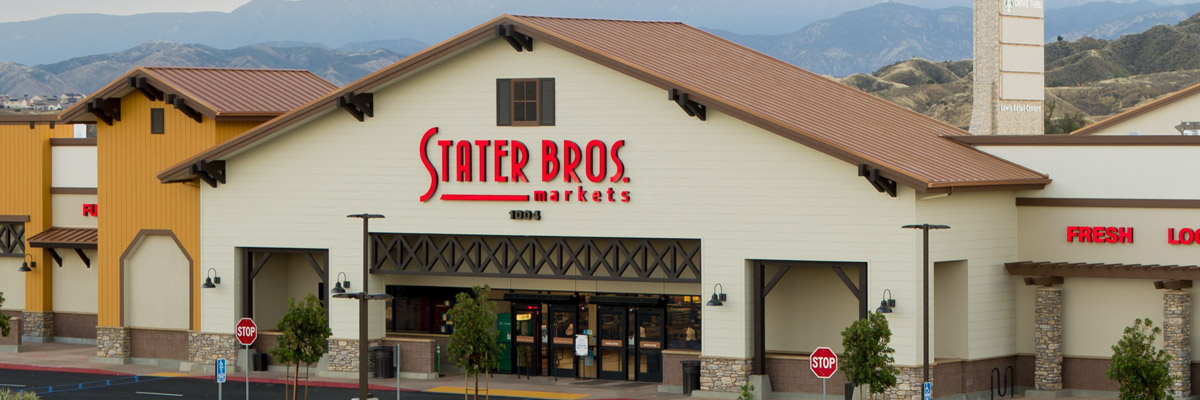
Stater Bros. Markets, the largest privately owned grocery retailer in Southern California, has become the latest retailer to work with In-Store Marketplace (ISM), which claims to be “the retail industry’s first centralised platform for digital in-store media integration”.
Through this partnership, Stater Bros. will leverage ISM’s programmatic platform for in-store media integration combined with Mood Media’s existing hardware footprint, enabling streamlined campaign activation, centralised inventory management, targeting and programmatic buying capabilities.
The first phase of the rollout will focus on in-store audio, delivering timely, contextually relevant messaging to shoppers at the moment of purchase. Future phases will expand the network to include digital screens, creating a unified in-store media ecosystem that enables brands to engage Stater Bros. shoppers through multiple touchpoints using a single point of entry.
With more than 2.5 million weekly store visits, Stater Bros. offers advertisers access to one of Southern California’s most loyal and locally rooted shopper bases. Nearly half of Stater Bros. shoppers identify as Hispanic or Latino, with higher-than-average household income and a demonstrated openness to product discovery and trial, making the in-store environment a powerful channel for brand-building and performance-driven campaigns.
“Regional grocers like Stater Bros. represent one of the most compelling opportunities in retail media today,” says Paul Brenner, SVP of Global Retail Media and Partnerships for ISM. “Their focused footprint and trusted customer relationships enable brands to connect with shoppers in ways that feel relevant and impactful. By bringing together ISM’s retail media platform and Mood Media’s in-store technology, we’re building a scalable solution designed to support Stater Bros.’ long-term growth.”
Is this the future of in-store retail media?
Retail media has become one of the fastest-growing channels in marketing, with US advertisers projected to spend $71.09 billion in 2026. The Stater Bros. partnership advances ISM’s expansion into regional grocery, where strong shopper engagement provides differentiated value for brands. Nearly 80% of shoppers say they trust their neighbourhood brick-and-mortar grocery store more than national giants like Amazon or Walmart to offer fair, personalised deals.
“Stater Bros. Markets has always been focused on service to our customers and our community,” says Denise Singler, VP of Integrated Marketing at Stater Bros. Markets. “This partnership enables us to thoughtfully introduce in-store media in a way that complements the shopping experience while supporting our community and our vendor partners in a way that stays true to our 90-year history as Southern California’s local grocer.”
Inventory for the in-store audio network will be sold through Vibenomics, enabling brands to activate campaigns at scale seamlessly.
Early success for the partnership will be measured by advertiser demand, shopper receptivity and the ability to deliver meaningful value without disrupting the in-store experience, laying the groundwork for future expansion as digital screens come in-store later this year.
At first glance, this deal looks like another incremental step in the steady build-out of retail media networks. But scratch beneath the surface and it speaks to a more consequential shift: the race to turn the physical store into a fully addressable, programmatic media channel that finally begins to resemble the sophistication of its online counterpart.
That framing matters. Retail media’s explosive growth has largely been built on digital surfaces: sponsored search, display ads on retailer sites and offsite targeting powered by first-party data. The store, despite accounting for the majority of grocery transactions, has remained comparatively under-monetised and technologically fragmented. ISM’s pitch is that it can change that by stitching together disparate in-store channels into something closer to a unified, programmatic ecosystem.
A sound investment
Audio might seem like an unambitious starting point. After all, in-store radio has been a staple of supermarket environments for decades. But the distinction here is less about the format and more about the infrastructure behind it. Traditional in-store audio has been largely static, centrally programmed playlists with occasional pre-booked ad slots. What ISM and its partners are attempting is to make that inventory dynamic, targetable and measurable.
In other words, to treat a store aisle more like a digital ad impression than a captive audience.
That ambition aligns with a broader industry push to “digitise the aisle”. ISM is not alone in this regard. Kroger’s Precision Marketing arm has been expanding its in-store capabilities, linking loyalty data with digital screens and shelf-edge displays. Walmart has built out Walmart Connect to integrate in-store signage with its broader media network, while Tesco has experimented with connected screens and data-driven targeting through its retail media partnerships. Each of these efforts reflects the same underlying logic: the closer a media touchpoint is to the moment of purchase, the greater its potential value.
What differentiates ISM’s approach is its positioning as a centralised, interoperable layer rather than a retailer-specific walled garden. That’s a subtle but important distinction. One of the biggest barriers to scaling in-store retail media has been fragmentation – different hardware vendors, inconsistent formats, and a lack of standardised buying mechanisms. By integrating with an established infrastructure player like Mood Media and plugging into programmatic demand via Vibenomics, ISM is effectively trying to create a common operating system for physical retail environments.
Simplifying the complex
This is not ISM’s first attempt to tackle that challenge. The company has previously worked on integrating multiple in-store channels – audio, digital signage and experiential touchpoints – into single campaign workflows for brands looking to activate across store networks. Its broader proposition has been to simplify what is currently a complex, bespoke process into something closer to the plug-and-play model advertisers are used to online.
The Stater Bros. deal is significant because it brings that model into the regional grocery segment, which has historically been harder to standardise but arguably offers richer, more loyal audiences.
And that’s where the second layer of this story comes into focus. Stater Bros. Singler’s emphasis on maintaining the retailer’s “90-year history as Southern California’s local grocer” hints at a tension that runs through the entire retail media space. On one hand, retailers are under pressure to unlock new revenue streams and compete with giants like Amazon and Walmart. On the other, they risk eroding the very trust and intimacy that make their audiences valuable in the first place.
ISM’s bet is that better targeting and more contextually relevant messaging can square that circle – that ads delivered at the right moment, in the right tone, can enhance rather than disrupt the shopping experience.
The statistic that nearly 80% of shoppers trust their local grocery store more than national giants, underscores the stakes. If in-store media is executed poorly, it could quickly feel intrusive. If done well, it has the potential to become one of the most effective forms of shopper marketing.
There are early signals from elsewhere in the market that this balance is achievable. Networks like Albertsons Media Collective have been experimenting with in-store digital formats tied to loyalty data, while European players such as Carrefour have invested in connected store environments that blend media, data and merchandising.
In each case, the goal is the same: to create a seamless bridge between online targeting capabilities and offline purchasing behaviour.
What the Stater Bros. partnership illustrates is that this evolution is no longer confined to the largest, most technologically advanced retailers. Regional players, with their concentrated footprints and deeply embedded customer relationships, are becoming the next frontier. For advertisers, that opens up new opportunities to reach highly engaged audiences in environments that are less saturated – and potentially more trusted – than national chains.
The real test will come as ISM expands beyond audio into a fully integrated in-store media network. Screens, shelf-edge displays and other digital touchpoints will bring greater creative flexibility and data opportunities, but also greater complexity. Success will depend on whether ISM can deliver on its promise of a unified, easy-to-buy platform while preserving the integrity of the in-store experience.
In that sense, this deal is less about reinventing in-store audio and more about redefining what the store itself represents in the media mix.
For years, retail media has been synonymous with ecommerce. Increasingly, the industry is recognising that the physical store – long treated as a purely transactional space – may be its most valuable, and most underutilised, asset.