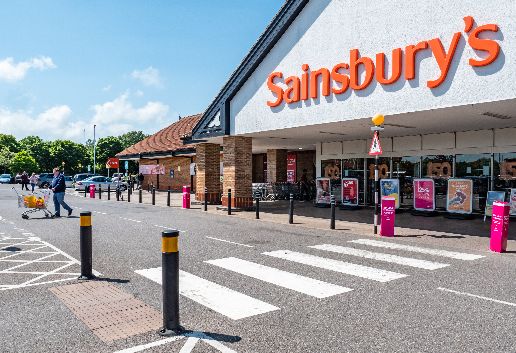
Sainsbury’s has outperformed the market on groceries, delivering 3.6% growth year-on-year, with sales at £7.6 bn, according to its first quarter trading statement for 2026-2027.
Groceries delivered most of Sainsbury’s total growth – 2.1% year-on-year with total sales (excluding fuel) of £9.1 bn. However, this, is below analysts’ consensus forecast of 2.7% and the 3.1% achieved in the previous quarter, with Argos and Tu proving to be a drag on the business. Argos sales fell 0.5% and Tu clothing 2.1% year-on-year. Sainsbury’s pointed to a fall in discretionary spending as the war in the Middle East and ongoing economic and political uncertainty continue to impact consumer confidence.
“An encouraging start”
Nonetheless, Simon Roberts, chief executive of J Sainsbury plc, described the results as an “encouraging start” to 2026/27. “We’ve kept our strong focus on value, with the biggest Aldi Price Match in the market, across supermarkets and convenience stores, and Nectar Prices on around 11,000 products,” he said.
“Leading product innovation and outstanding quality fresh food set our offer apart, with standout performances in summer favourites like berries, barbecue and deli. And we’re achieving record customer satisfaction scores on availability in supermarkets and complete orders in Groceries Online, reflecting strong operational momentum. This combination is really delivering at the big customer moments and we outperformed the market at Mother’s Day, Eid al Fitr, Easter and the May heatwave.
He added: “As customers make more considered food choices, we’re going further to make healthy everyday essentials more accessible and affordable, starting with fibre, fruit and veg. From new products and reformulation to clear Full on Fibre labelling on over 500 products, we’re making it easier for families to choose healthier options.”
Investors remain unconvinced
The company’s full-year profit guidance remains unchanged, but Chris Beauchamp, chief market analyst at investing and trading platform IG, described the shares as a “disappointment.” He said: “Today’s numbers from Sainsbury’s are more of the same from Britain’s second supermarket, and might help prop up the shares in the short-term. But the shares have been such a disappointment for decades, returning a miserable 3.3% per year since 1991, compared to Tesco’s near-10%, that you could be forgiven for wondering what the supermarket can do to excite investors.”
Sainsbury’s strong grocery sales and a relentless focus on value keep customers coming back, but with discretionary spending under pressure and investors still unconvinced, the retailer faces a familiar challenge: turning operational success into shareholder excitement.
Stay informed
Our editor carefully curates two newsletters a week filled with up-to-date news, analysis and research. Click here to subscribe to the FREE newsletter sent straight to your inbox. Why not follow us on LinkedIn to receive the latest updates on our research and analysis?