New research suggests that, despite all the hype around agentic shopping, there is still a significant gap between what AI-powered shopping assistants promise and what they actually deliver.
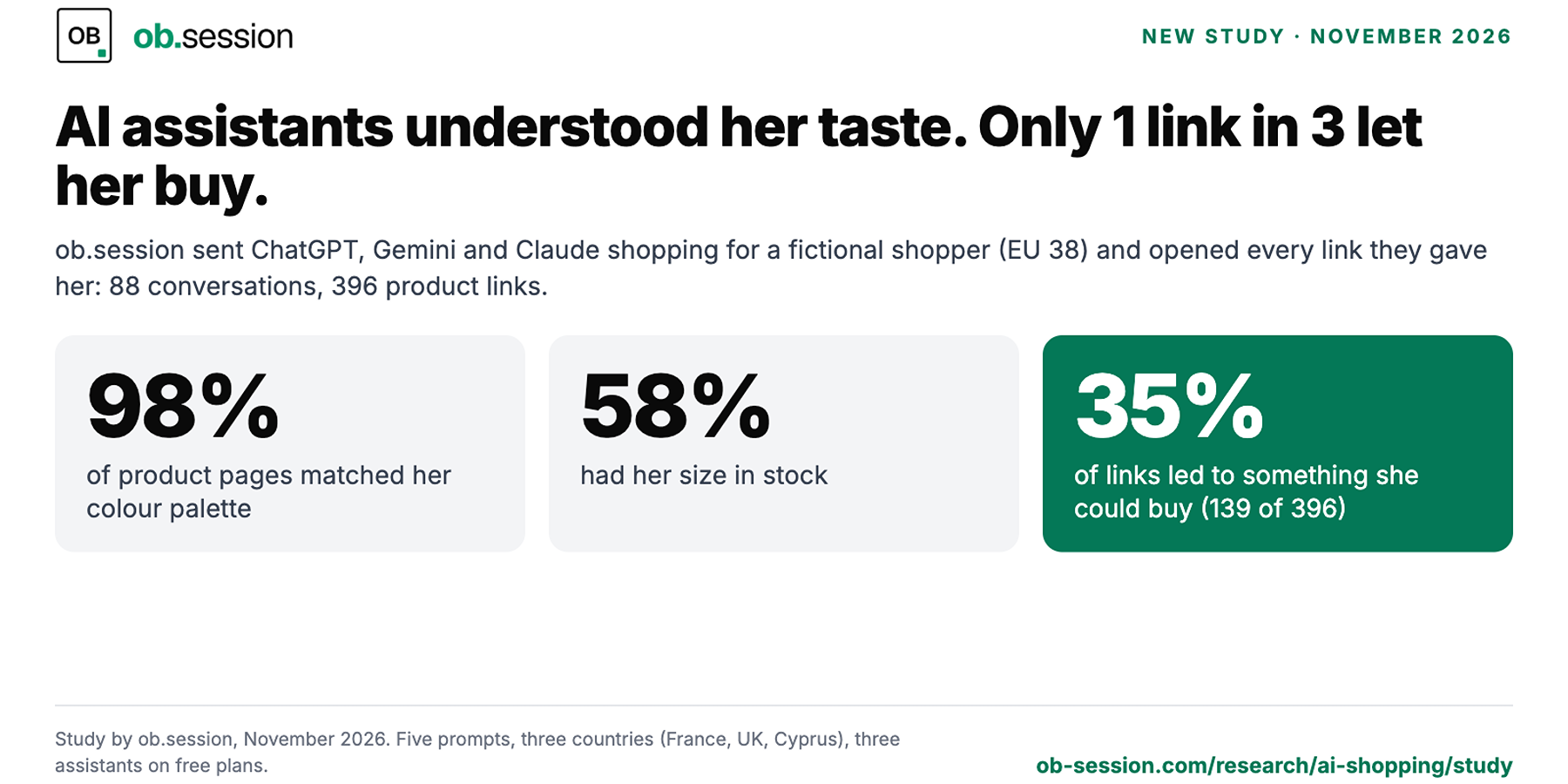
ob.session, a real-time product recommendation engine for Shopify stores, sent ChatGPT, Gemini and Claude shopping on behalf of a fictional customer, Laura, a UK size 10 shopper based variously in France, the UK and Cyprus. Every product link recommended by the large language models (LLMs) was opened and checked against her size, shopping brief and location.
The results were sobering. Across more than 400 product links tested, the LLMs’ recommendations were only in stock 35% of the time, meaning that in nearly two-thirds of cases the suggested item was unavailable.
ChatGPT most effective of those tested
Of the three models tested, ChatGPT was the most effective at providing usable recommendations, successfully delivering Laura’s chosen item in the correct size and location 45% of the time. Gemini achieved a success rate of 33%, while Claude managed 21%.
The main cause of failure was simple availability. In 29% of cases, the retailer had sold out of Laura’s size, preventing the recommendation from being fulfilled even when the product itself was still listed.
For ecommerce retailers hoping AI shopping agents will become a powerful new sales channel, the findings highlight a significant challenge. If agents cannot reliably surface products that are actually available, retailers risk damaging trust and customer loyalty before transactions even begin.
Trust is at risk
Ksenia Sukhova, co-founder and CCO of ob.session, said: “When the information an LLM relies on is outdated, contradicts itself, or doesn’t clearly show availability, trust is lost on two sides: firstly, retailers lose trust as merchants. A shopper arrives after seeing a product they liked, and it isn’t there (for example, their size is missing). That is very disappointing. Secondly, LLMs lose trust too. If most of the products they recommend aren’t available, users stop believing the recommendations.”
She argues that retailers are caught in something of a catch-22. “If LLMs improve their search quality, they simply won’t cite sources that are self-contradictory or incomplete. Those retailers won’t be shown at all. But if LLMs don’t improve, or a flawed listing slips through, the retailer still loses the customer’s trust.”
To improve their chances of being accurately represented by AI shopping agents, Sukhova recommends that retailers:
- Put size-level stock availability into the machine-readable version of the site. This means a structured version, not content that JS renders afterward. A simple available / unavailable or in-stock / out-of-stock flag isn’t enough. The LLM should be able to check each size separately.
- Expose every attribute shoppers search and filter by in that same structured version. That includes fabric, colour and so on. This data must not contradict what’s shown in the listing.
- Double-check this data carefully so it’s accurate.
Retailers need to get their data house in order
The findings suggest the future of agentic commerce may depend less on advances in AI models and more on the quality of the data retailers provide. Until stock availability and product attributes are exposed in ways that AI agents can reliably interpret, shoppers may find that AI-generated recommendations lead to frustration rather than convenience. For retailers, improving structured product data could become just as important as optimising websites for search engines was in the last era of digital commerce.
Stay informed
Our editor carefully curates two newsletters a week filled with up-to-date news, analysis and research. Click here to subscribe to the FREE newsletter sent straight to your inbox. Why not follow us on LinkedIn to receive the latest updates on our research and analysis?