
AI agentic commerce is promising to alter product discovery and force RMNs and brand advertisers to rethink strategies that have driven retail media growth for the past decade, says Colin Lewis.
Imagine your own personal shopper – one who understands your habits, your taste and your budget! This shopper can look for all the options, all the deals and find the best product at the price you want to pay – or can afford – and pays for the product without you lifting a finger. Picture this running constantly in the background and never needing a break.
Welcome to the promise of agentic commerce. (Note, the emphasis here is on the word ‘promise’!).
The rise of AI shopping agents is already happening. AI agents—embedded in platforms like ChatGPT and Google Gemini—are starting to influence shopper decisions, changing how shoppers discover, consider and buy products online.
Amazon has launched Rufus and Walmart has launched Sparky as the AI agents. Walmart gave OpenAI certification to 3.5 million associates so they are trained on how to use AI tools to give advice to customers, and they added instant checkout through ChatGPT. Walmart also launched AI powered in-store shopping where they take a lot of what the shopper is doing digitally online or in app and apply it to the store – and they claim to see basket size increases of up 25%.
This is the promise. What about the flipside of the promise?
The downside of this promise is that, for retail media networks, AI agentic commerce looks like an existential crisis. The implication from a growing dependence on chat interfaces would mean that retailers would lose control of their proprietary access to customers, search traffic would disappear, collapsing the key source of traffic for retailers – search advertising.
To look at the upside and downside properly, let’s use a metaphor from the stock market: ‘bulls’ and ‘bears.’
The ‘Bulls’ and the ‘Bears’
A bull case represents the optimistic best-case scenario, where we can all be confident that everything goes exactly according to plan and the stock price will go up. ‘Number go up’ is the slang phrase for the bull case.
A bear case is more pessimistic outlook that assumes things might not be as rosy as promised, that human nature, technology or simply ‘events’ will happen that means the stock price will go down. ‘Number go down’ or ‘NGMI’ (not going to make it) is the slang phrase for the bear case in internet meme culture.
Before we dissect the rosy upside or the NGMI downside, let’s start at the basics. What do we actually mean by AI agentic commerce?
What is ‘agentic AI’ in retailing and digital commerce?
Agentic AI refers to systems that act on a user’s behalf. Instead of passively waiting for a customer to make a decision, these agents perform tasks, make choices, and purchases autonomously.
Here are some typical agentic AI promised use cases:
- Instead of shoppers manually searching and comparing across websites and apps, AI agents will scan several platforms, filter results against individual preferences, compare features and prices, and make recommendations.
- AI agents will understand shopper preferences, for example, plan an entire weekly shop based on your individual goals — whether that’s budget constraints, nutritional requirements, household needs, or ingredient preferences.
- AI agents will parse all the options available, continuously monitor prices and automatically reorder products when they hit the right threshold.
- AI agents will negotiate in the background — looking at promotions, loyalty benefits, availability, and know your preferences to get you the best deal.
- As human trust in AI agents grows, agents will do the transactions tasks—checking delivery timelines, using stored credit cards, and completing a purchase – without intervention. In other words, shoppers will delegate tasks to agents and also manage the tracking of shipments and the handling of returns.
Andrew Lipsman points out that “AI agents act on behalf of consumers to handle the entire buying process” is ‘still the most widely used and widely understood interpretation and is a vision of the future of commerce that many subscribe to.’
The ‘Bull Case’ for the impact on retail media by the rise of AI agentic commerce
The ‘Bull Case’ for retail media is that AI-agentic becomes a new source of demand rather than a threat. What would this look like?
- Retailers gain in power: Agents need structured, enriched real time data to make decisions and recommendations. Retailers already hold this sort of data. Any retailer with excellent first party data becomes more valuable as the information will be very important for AI platforms.
- Product content becomes a competitive differentiator: Agents need structured data over lifestyle-led visuals, but shoppers like lifestyle visuals, curation and great content to help them make decisions. Retailers that have standardised, enriched and optimised their catalogues automatically have an advantage
- Category dynamics play in retailers’ favour: Repeat categories with stable preferences (grocery, pharmacy, mass electronics) are ideal for agentic automation. Retailers already dominate these categories and AI-agents could channel more demand to places where the data is cleanest and fulfilment is reliable, which will mean shoppers and more retail media revenue.
- Brands raise their content game and partner with retailers to ensure that their brands are found: execution: If AI-agents read structured content rather than lifestyle assets and threaten commoditisation, brands have to improve their product feeds, attributes and their relationships with their primary distribution point – retailers.
- Retailers improve their omnichannel capabilities: Retailers double down on the monetisable real estate that they have that AI-agentic commerce cannot touch – instore and offsite advertising.
- Retailers launch their own agents — and keep demand inside their network: retailers don’t sit passively waiting for Amazon, Google or OpenAI to define AI-agentic commerce. Instead, they launch:
- retailer-branded agents
- loyalty-personalised assistants
- shopper-specific recipe/trip-planning agents
- replenishment agents
Each of these keeps shoppers inside the retailer’s ecosystem and reinforce the value of RMN audiences.
- API-enabled partnerships increase data licensing revenue: Bigger, more powerful retailers could offer structured access to their catalogues and signals (availability, pricing, local assortments). AI platforms could pay to license this data.
- Agents increase conversion and basket profitability: AI-agents reduce friction and cognitive load as they aid discovery and conversion. In this case, basket conversion and size would increase. Retail media revenue would grow because the core retail business grows.
The ‘Bear Case’ for the impact on retail media by the rise of AI agentic commerce
The social media driven bear case for AI agentic commerce and its impact on retailers, brands and retail media goes something like this:
- “AI agentic commerce will kill retailers.”
- “AI agentic commerce will kill brands.”
- “AI agentic commerce will kill loyalty.”
- “AI agentic commerce will kill creativity.”
And of course:
- “AI agentic commerce will kill retail media”.
In other words, AI agentic commerce disintermediates retail media. Agents become the aggregators, not the retailers. Product choice collapses into a handful of ranked results surfaced by AI systems that sit outside retailer control. AI agentic commerce will monetise discovery and disintermediate retailers. Retail media is ‘NGMI.’
Social media ‘hot takes’ are one thing, but what do the experts say?
Kiri Masters lays out the ‘bear’ case for retailers succinctly. Masters points out that the maths is stark: when consumers stop browsing retailer websites and start telling ChatGPT “build me a shopping basket for tacos tonight,” three things happen:
- On-site advertising revenue (70-80% margins) vanishes – no more sponsored product listings or display banners when shoppers never visit your site.
- Off-site data monetization (40% margins) gets watered down – that exclusive first-party data retailers sell to advertisers becomes less valuable when AI agents also have transaction records across multiple retailers.
- Physical trade marketing (near 100% margins) becomes the safe bet – people will still visit stores and see endcaps, making old-school in-store advertising the most disruption-proof revenue stream.
Anne-Clare Baschet, Chief Data and AI officer at Mirakl points out that ‘more than 60% of shoppers are using AI at some stage in their shopper journey’. The first effect is that if shoppers are using AI powered chat interfaces for discovery, they are describing their problem and the context, and getting the answers through a chat interface. This means that:
- Shoppers are starting to search with more words to clarify their needs (since April 2025 vs April 2024 that 35% of customers are searching with 8 words or more).
- Searches have expanded from 2-3 keywords to detailed, contextual descriptions, that are intent led. 37% of shoppers now using more than eight words in AI platform searches (up from just 4% in August 2024).
Given that sponsored products are about 80% of all retail media revenues and this is dependent on shoppers searching onsite or on apps, retailers will need to be careful with just relying on keywords for their retail media revenue base.
As Baschet points out, this could be the biggest change in search since Yahoo vs Google in the early part of the century. Retailers will need to think more about how to capture shopper intent more than ever.
The ‘Bull’ and the ‘Bear’ Case: lessons from the past
If you grew up with 1980s pop culture, you will have heard a song called ‘Video Killed the Radio Star’.
In the 1980s, the music business was in turmoil over two threats to the industry: the rise of video and the rise of electronic synthesisers. Both were supposedly going to ‘kill’ the music industry as video would mean we would no longer listen to radio and synthesisers were going to put all musicians out of a job.
What actually happened? The music industry had the biggest bonanza ever in the following two decades as video spurred on sales as music TV became a visual discovery for new music and synthesisers created a whole new genre of music.
Video did not kill the radio star and MTV did not make radio irrelevant. Nothing got replaced. Instead there was more fragmentation and new models emerged. Agentic AI will be another channel for retail and digital commerce
Michael Islip, Founder at Grace & Co believes that the challenge of AI Agentic commerce is that ‘most new things are additive. Another channel, another format, another data set….’
Viv Craske, my co-host of the Retail Media Therapy podcast says that ‘from an eCommerce perspective, agentic-assisted shopping will likely increase online sales (particularly in hard-to-do/boring-to-do sectors like food shopping), so agentic offers an opportunity for more retail to happen.’ He argues that ‘contactless cards (in physical retail) and online wallets (in online retail) made it easier to buy more stuff… and agents will see the same result too.’
The Bull and Bear Case: realities of consumers and retailers
Assuming a future according to what a technology is (theoretically) able to do vs. how consumers are likely to interact with a technology on a regular basis is not the basis of a proper strategy, and, to say the least, has not proven to be reliable in the past.
Quoting Andrew Lipsman: ‘there’s just one minor detail they fail to properly consider: the consumer. We over-attribute the tech and under-attribute the human in the equation.’
Not all retail categories are the same. Not all purchases are the same. Buying a charger and a cable for your iPhone is very different to decorating your house or buying make-up. Every category has different degrees of importance to us.
The role of AI agentic commerce will vary
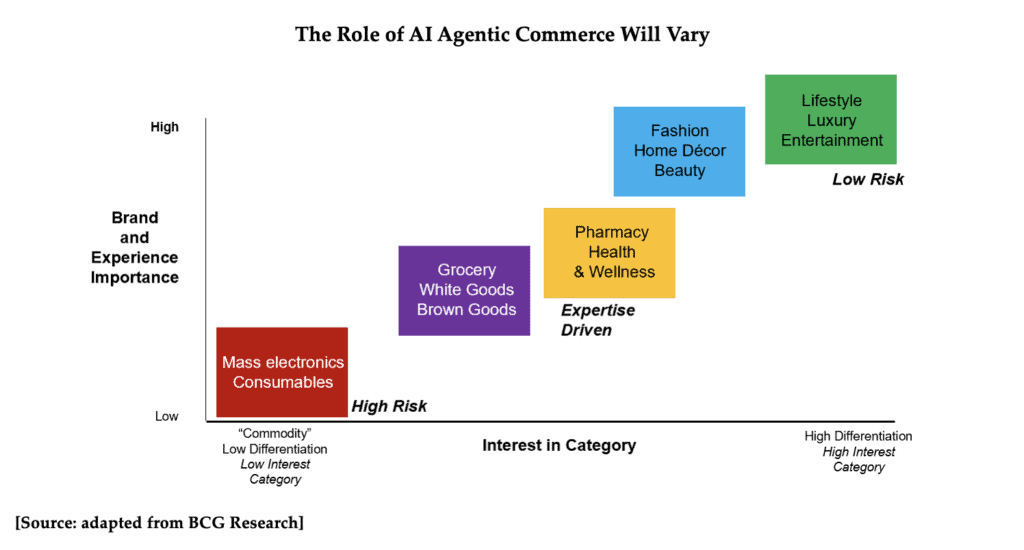
The more that we are interested, or even passionate about a category, the less likely that we will hive it off to an agent.
Eric Seufert of MobileDevMemo doubles down on the argument against AI-agentic commerce from a retailers perspective with the following:
- The fundamental flaw with “agentic commerce” or “agentic advertising” is that it violates the motivations of retail outlets to 1) control the customer relationship and 2) monetize their first-party data with advertising.
- Retail platforms have no commercial motivation to allow third-party agents, broadly and without restriction, to browse their catalogue or to make purchases directly. If agentic commerce takes shape, it’s likely to occur through narrowly-scoped, explicit partnerships that tilt in favour of the platforms.
Forget the Bulls and Bears: what should RMNs and brands do?
As the saying goes, ‘prediction is very difficult, especially if it’s about the future.’
Instead of going ‘all-in’ on a bull or bear case, what should retail media networks and brands do to manage their risk factor?
First of all, you should create your own set of assumptions. Here are my set of assumptions about AI-agentic commerce
- Consumer adoption of AI-agentic commerce will grow, but shoppers will still want an in store experience.
- Some form of agent/LLM advertising propositions will launch from Google and OpenAI.
- How likely shoppers will adopt AI-agentic commerce depends on how AI-platforms can deliver a successful end-to-end experience. The probability that this will happen in all categories everywhere all at once is low (See how Andrew Lipsman explains this and make up your own probability)
- Some purchases might be delegated to agents (low-interest categories, repeat purchases).
- Some purchases will stay driven human and emotional (gifts, big-ticket and identity-driven purchases).
- Certain countries, demographics and cities will adopt AI-agentic commerce more than others. The shopper on the upper west side of New York City is likely to have a different approach to a shopper in Naples, Italy.
- New attribution models for agent/LLM advertising will emerge.
Tasks for retailers
The first priority is to think through whether you will deny LLMs access to your data to protect your advertising business or give open access to increase your distribution and discoverability options – and probably grow your advertising business.
Most retailers feel trapped between blocking agents entirely or becoming mere fulfillment centres according to Anne-Clare Baschet, Chief Data and AI officer at Mirakl. However, RMNs actually have advantages that such as first-party data, existing supplier and advertiser relationships, and existing revenue streams worth protecting.
The second priority is to keep your strategy flexible by doing the following:
- Make sure your own online, offsite and instore channels work to improve engagement & loyalty.
- Use the assets your have, particularly omnichannel capabilities to stand-out from digital-only agents. If sponsored search really does take a hit, having excellent offsite and instore capabilities can insulate RMN revenues.
- Think through new digital shopper journeys: Proactively work through potential new shopper journeys from LLM to landing page.
- Make product data/metadata is AI ready, readable and optimised for generative search so your landing pages can be found if linked from an AI-agentic assistant.
- Remember that shoppers like more visuals, less SKUs and less choices, but AI-agentic commerce agents are about lots of information, lots of text, lots of data, and like lots of SKUs.
- Track the AI ad formats that will inevitably come from the LLMs and adapt early.
- If you can’t beat them, join them: develop your own AI agents to support your business. Anne-Clare Baschet calls these ‘retailer-controlled agentic interfaces’ which is where retailers build their own AI assistant capabilities while maintaining interoperability. Baschet believes that the foundation for any approach is treating AI assistants as VIP customers: structured, API-accessible product data with real-time inventory and pricing capabilities.
Tasks for brands
For brands, the challenge is just as tricky as it is for retailers. ‘We don’t know what could happen, but we still need to be ready’ is not exactly ideal as a line on your annual marketing plan!
Nevertheless, there are things that brands can do:
Embed AI-agentic thinking into your strategy and decision making to ensure you are ready: Ben Rickard believes that ‘smart brands are starting to prepare for a two tier internet for digital marketing and commerce activities made up of the ‘human web’ (as we know it today) and agentic Web for agents and automation. Brands will need an answer and set of solutions for both of these in the future.’
The idea of having a powerful brand will become even more important – having clear distinctive assets and ‘mental availability’ (per Prof Byron Sharp and Prof Jenny Romaniuk) will now become even more important.
And, like retailers….
- Think through new digital shopper journeys: Proactively work through potential new shopper journeys from LLM to landing page.
- From SEO to GXO: SEO is optimisation for indexed pages and GXO is optimisation for generative outputs and an AI agentic world. To do this we have to
- Make content AI-readable and have structure data so agents can interpret it
- Label product information in ways models recognise
- Ensuring catalogues, claims, attributes and reviews can be pulled into generated results
- Remember that shoppers like more visuals, less SKUs and less choices, but AI-agentic commerce agents are about lots of information, lots of text, lots of data, and like lots of SKUs.
- Track the AI ad formats that will inevitably come from the LLMs and adapt early.
Summary for Bulls and Bears
Are you a bull or bear? Strategic thinking acknowledges where both bull and bear cases can be true at the same time. For example:
- Agents might reduce retailer search traffic (bear case) while increasing retailer data licensing revenue (bull case).
- Agents might disintermediate choice (bear case) while improving conversion and ROI for brands who adapt (bull case).
Maybe we should not care if we are a bull or a bear, and instead put our energy into creating a retail media system that can hold up under either scenario.