

In the latest RetailX Offsite Data Workbench report, carried out in association with Koddi, it was found that offsite is gaining huge interest and deployment among advertisers and retailers. But, while it is easy to see how they want to make it work, what are the ways in which they need to target consumers?
By looking at ConsumerX data on how shoppers shop and connecting that with Koddi’s survey data of 126 US marketing professionals, we can see how the content and channels used for offsite matter to consumers.
Key findings
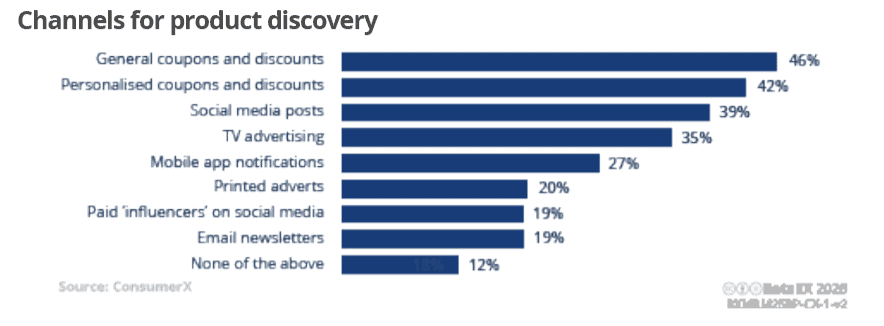
Discounts and deals drive discovery – With 42% of consumers responding to personalised offers, promotions are central to product discovery. Offsite retail media plays a critical role here, with shopper data allowing personalised offers across social, video and display. Advertisers that link deals to targeted ads will outperform those using generic messaging.
Social media is a core discovery engine – It is no wonder that social is currently the main offsite target for advertisers, with 39% of consumers discovering products via social posts, making it the third-most influential channel. Retailers should integrate retailer data into social ad targeting to reach high-intent audiences, while opportunities for shoppable ads on TikTok, Instagram and YouTube Shorts have to be exploited. Organic content and creator-led storytelling are more trusted than influencer partnerships alone.
Video advertising, including CTV, adds power – 34.7% discover products via TV advertising, but linear TV is fragmenting. The growth of CTV, YouTube and streaming ad formats makes offsite retail media a natural fit: combining retailer shopper data with CTV targeting lets brands reach precise segments while measuring incremental sales impact.
Authenticity beats influence – Social posts (38.6%) outperform paid influencers (19.4%) almost 2:1, meaning that consumers engage more when discovery feels organic and unforced. For brands, this means shifting budget toward UGC ads co-created with creators, rather than overt sponsorships and retail media-powered authentic content amplification.
Strategic implications
Social, video, and personalised offers dominate product discovery. Retailers and advertisers need integrated offsite activations leveraging retailer data across here.
Linking shopper insights with offsite activations
enables precision targeting that delivers personalised discounts via social ads and CTV. This approach can
also retarget known audiences across display, video and influencer-led campaigns.
Consumers interact with multiple touchpoints. Because of this, retailers must offer unified campaign management and cross-channel measurement within retail media networks.
Budget allocation should move from one-off influencer partnerships to scalable content-driven campaigns amplified through retail media.
Offsite campaigns connecting retailer data with contextual placement and personalisation will capture discovery moments more effectively than generic ads.
Key findings:
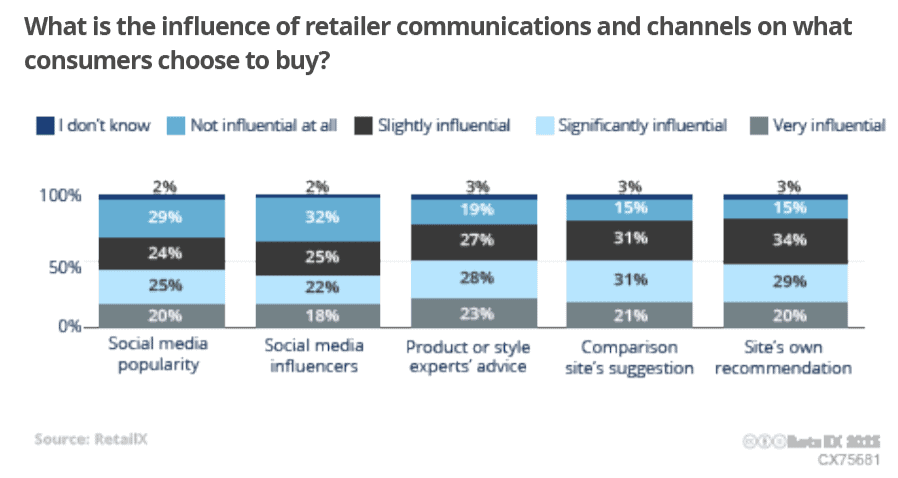
Trust drives conversion more than popularity – Experts (51%) and comparison sites (51%) top the list and consumers lean on trusted, data-driven or expert voices over popularity signals. For offsite retail media, this means partnering with credible sources (experts, comparison engines) is more effective than pure influencer-led campaigns.
Retailer recommendations have weight, but need transparency – Almost half (49%) find site recommendations influential, but the split suggests consumers may be sceptical of bias. Retailers must ensure personalisation, relevance and proof of value in their recommendation engines to win trust.
Social media is polarising – While 44% find popularity and 41% influencers influential, an equal or greater share are not swayed by them at all. This signals that social-led offsite retail media is effective for certain audiences (younger, trend-driven), but not universal. Retailers and brands should segment campaigns carefully rather than rely solely on social buzz.
Neutral and independent sources outperform paid influence – Comparison sites rank higher than social channels, showing that independence and transparency drive purchase decisions. This suggests retailers should consider partnerships with third-party review or comparison platforms as part of offsite
retail media.
Opportunity for hybrid strategies – The data shows no single channel dominates; consumers are influenced by a mix of expert, independent and algorithm-driven recommendations. Retailers and brands need to integrate offsite activations across multiple sources, with AI personalisation to make them feel less like ads and more like advice..
Strategic implications:
Prioritise credibility over hype and invest more in expert-led content, trusted reviews and comparison partnerships, rather than relying purely on influencers.
Social media still matters, but requires audience segmentation (Gen Z, early adopters). For broader audiences, social should support awareness, while experts and comparison sites close the deal.
Brands should consider offsite partnerships with trusted third parties such as review aggregators, affiliate networks and content publishers as a new way to market their wares.
Closed-loop attribution will be key: retailers that can prove conversion uplift from expert/neutral channels versus influencer/social campaigns will gain brand trust and budgets.
Key findings
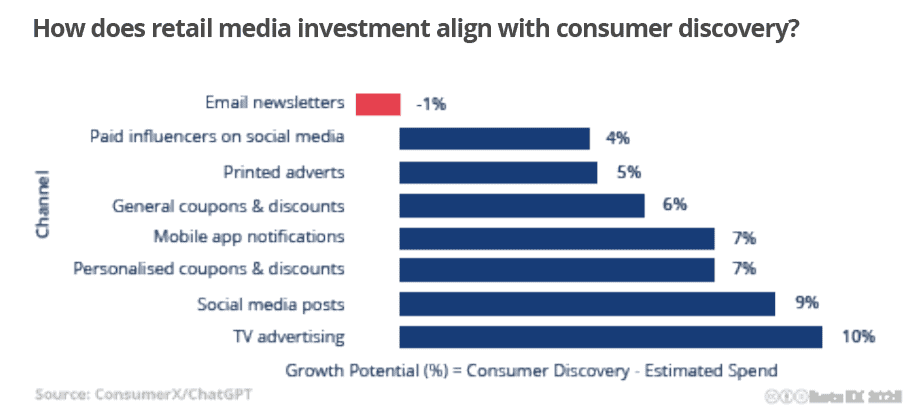
Top underinvested channels – The data shows that the key channels that make up offsite are currently underinvested when compared to how consumers want to discover and buy. Opportunities include:
– Personalised coupons and discounts: There is a high consumer demand for relevant, data-driven offers and there is an opportunity to integrate retailer first-party data into offsite ad formats for hyper-targeted promotions, but this needs investment to reach its actual potential.
– Social media posts: Organic plus shoppable content drives discovery far more than most budgets allow today. This suggests expanding retail media activations across TikTok, Instagram and YouTube Shorts.
– TV and CTV advertising: Traditional and connected video formats are still influential discovery drivers, and the opportunity lies around pairing retailer data and CTV targeting in order to optimise incremental reach and conversion.
Balanced channels – General coupons and discounts (+5.6%) are in a good place, but there’s still room for scaling omnichannel distribution. Mobile app notifications (+7.1%) show how owned channels are underutilised for product discovery currently.
Potential overspend zones – areas where there is an overspend relative to how consumers engage include:
– Paid influencers on social: Consumers are twice as likely to react to organic posts rather than to paid influencer content. Budgets could shift from influencer fees toward amplifying UGC via offsite retail media
– Printed adverts (-4.5%): Lower consumer discovery impact than current investment implies. This suggests reallocating spend toward digital-first discovery formats will be beneficial.
Strategic implications
Retailers and advertisers must activate data-driven discounts across social, CTV and display and scale shoppable social using retail media-powered targeting to amplify authentic, organic content.
Integrating CTV into offsite retail media to leverage first-party shopper data for precision targeting on streaming platforms should be high on the agenda.
Rebalance influencer spend by focusing on creator-led campaigns and retail audience extension instead of high-cost sponsorships.
Reallocate traditional spend to shift budgets gradually from print and linear formats toward personalised, omnichannel digital activations.
To learn more, download the RetailX Offsite data workbench report in association with Koddi, which takes Koddi’s survey data and RetailX consumer data to assess the trajectory of the offsite retail media sector, offering a data analysis, a deep dive into implications, a range of case studies and company profiles that show offsite in action and a boardroom brief and roadmap as to where to go next.