

Marketplaces are booming worldwide and are becoming a significant part of global ecommerce. The biggest digital marketplaces are colossal. With their scale, marketplaces like Amazon, Alibaba, Mercado Libre, AirBnB and Uber have become household names. Although many brands still don’t understand them, retailers have recognised they can supercharge their retail media business, says Colin Lewis.
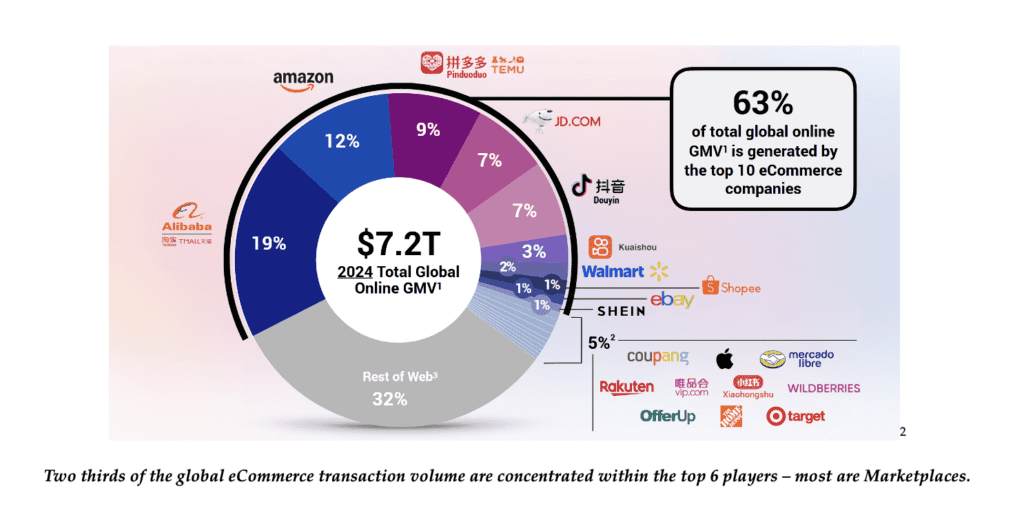
Global ecommerce merchandise volume is dominated by ten companies. Two-thirds of global ecommerce transaction volume is concentrated within six players.
What are these businesses? Marketplaces. We can say with confidence that ecommerce is a mostly a marketplace business, with third-party sellers generating 83% of online GMV for the top 15 ecommerce players.
Marketplaces Scale

In 2024, Alibaba’s marketplace model (primarily Taobao and Tmall) had a total Gross Merchandise Volume (GMV) estimated to be $1.2 trillion to $1.3 trillion. If Alibaba were a country, it would rank as the 18th or 19th largest economy in the world, just behind the Netherlands and Saudi Arabia.
The largest online retailer in the US is not Amazon, but the Amazon Marketplace. Third-party sellers (independent businesses) now account for the vast majority of Amazon’s commerce. In 2024, approximately 62% of all units sold on Amazon came from 3P sellers. Twenty-five cents of every dollar spent shopping online goes to the Amazon third-party marketplace. If the Amazon Marketplace (GMV) were a sovereign nation, its economy would rank as the 21st or 22nd largest in the world by nominal GDP in 2024, ahead of 170 countries, including major G20 nations like Argentina and South Africa.
What is a marketplace?
Marketplaces are aggregators of products where the shopper can compare and buy goods from numerous suppliers online. Marketplaces create a direct sales opportunity without the need for them to create their own platform. The marketplace owner manages suppliers, product choice, and collects commissions while sellers typically manage all other tasks.
Marketplaces perceptions
Given their scale and important, you would imagine that marketplace would get a larger share of the strategy and tactics for brands and retailers.
It’s true that Amazon is now at the centre of many top brands distribution plans. Many brands had a perception that marketplaces are purely price-driven. That changed a lot over the last few years, as bigger brands, in particular, realised they needed to control how their brands are distributed on marketplaces.
As Martin Heubel writes, there are lots of common misconceptions about marketplaces like Amazon:
- ‘It’s just another sales channel’
- ‘Our strong brand attracts sales by itself’
- ‘We don’t have the expertise to copy our products’
- ‘Amazon is too small to change our distribution strategy’
Heubel points out that all these views come from a position of naivety: they really just do not understand the marketplaces.
Marketplaces match demand with supply for which the marketplace gets a ‘cut’ of the financial transaction for finding and matching supply and demand efficiently. Marketplaces generally do not own any stock and do not provide the product or brand directly.
A true marketplace is two-sided – you need to acquire consumers and aggregate suppliers simultaneously. In theory, it should become easier to acquire the next consumer and the next supplier as the marketplace grows. In practice, finding scale on both sides of the business—buyers and sellers—is one of the hardest things to achieve when setting up a marketplace.
So far, so easy to understand. However, there are another three dimensions to understand:
- The consumer perspective on marketplaces.
- The brand opportunity with marketplaces.
- The investor opportunity with marketplaces.
The consumer perspective on marketplaces
Marketplaces offer consumers a one-stop shop for shopping discovery, research, and purchasing and they now dominate nearly every stage of the purchase journey in the US and the UK. Retailers, not search engines or social networks, still own commerce intent at scale.
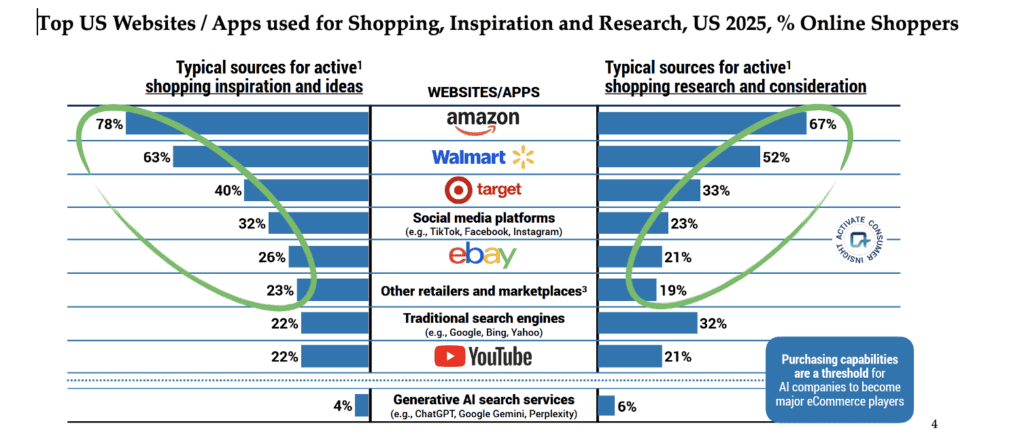
Amazon and Walmart dominate both shopping inspiration and purchase consideration in the US. Social platforms influence discovery but lag in conversion, while generative AI remains nascent.
New research from Akeneo with 1,800 consumers across eight countries and found that UK shoppers, for high‑value purchases over £90, shoppers rely more on marketplaces than any other digital or physical touchpoint. 30% of consumers regularly use marketplaces to buy products, ahead of stores and retailer sites, while 21% use marketplaces to initiate returns, second only to other routes at 22%.
Akeneo’s research found that 24% of consumers use them for search and discovery, 26% for price and promotions comparisons, and 28% to compare or validate products. They are also where shoppers seek peer guidance, with 26% leaving reviews and 21% turning to marketplaces for advice from other users.
While Amazon is a ‘search marketplace” (where people go when they already know what they want), TikTok Shop is a “discovery marketplace” (where people buy things they didn’t know they wanted until they saw them in a video).
The brand opportunity with marketplaces
Here are ten reasons why marketplaces are an opportunity for brands:
- Access to customers: If you want to be where potential customers are, a distribution strategy must include expanding through Marketplaces to reach them.
- Ease of access to international markets: Marketplaces offer access to new international markets at a much lower cost than if a brand had to establish its own presence in new markets on its own. For markets like China, marketplaces are the lion’s share of ecommerce – not brand.com websites.
- Fulfilment services: Fulfilment by the marketplace, for example, Amazon FBA can lower the cost of warehousing fulfilment and delivery for an ecommerce store. For a brand, controlling their own distribution is also an option, and it can just use the marketplace for selling.
- Product discovery: Shoppers search for products, not brands, which gives newer brands a better chance to compete with more established brands. Marketplaces increase the probability of being found, even by those who are looking for a specific product but do not know the brand.
- Ease of finding product for consumers: In ecommerce, the term ‘Discovery’ is used to describe the process by which consumers find products. With Marketplaces, products are categorised correctly, so are easier for consumers to find. Features such as ‘customers who viewed this item’ enable faster product research and improve the chances of discovery for smaller brands.
- Better customer data: Marketplaces are an effective way for brands to identify their most wanted products and study competitors’ pricing, as well as getting direct feedback from consumers through ratings and reviews
- Ease of use: Marketplaces such as Amazon, Etsy and even Alibaba have well-structured onboarding processes, and offer easy integrations from existing ecommerce platforms (for example, Shopify).
- Time to market: Brands can invest years to get a meeting with a retail buyer. On a marketplace, any brand can get on the virtual shelf with a monthly fee, some expertise and a couple of weeks of work.
- Consumer appeal: Shoppers can easily compare similar products, expect better prices as brands compete for prominence on the product page, and review all product details.
- Marketplaces as a democracy: The biggest name does NOT always win on marketplaces. This ease of access creates a highly competitive situation but also allows the smallest operators to compete on a level playing field using the same platform, tools, and techniques as global names.
The investor opportunity with marketplaces
From an investor perspective, marketplaces are great businesses for six reasons:
- Flywheel effect: The more users a marketplace has, the more its value increases with each additional user. The ability to attract more brands creates greater selection in the marketplace, driving higher consumer engagement and, in turn, higher sales for brands.
- Economies of scale: Once a marketplace has a strong network effect, it becomes increasingly difficult to enter or replicate it. As more consumers use the marketplace, their engagement increases, which increases marketplace volumes, which means more revenue for brands, which, in turn allows for faster and more efficient fulfilment of orders for consumers.
- Increasing brand awareness: Network effects and economies of scale mean even more brands and consumers. As scale increases, the network grows, which increases brand awareness in the marketplace and reduces the cost of acquiring consumers to visit the marketplace.
- Cost efficiency: Marketplaces do not carry stock, which means they are cheaper to operate than other channels. Think of the cost of running lots of stores versus running a website.
- Scalability: Not having any stock means a marketplace can scale exponentially.
- Flexibility: The lack of stores or stock, and a reliance on technology, means marketplaces can change plans and tack very quickly.
Marketplaces are ‘Internet Scale’
Investor Ram Parameswaran calls marketplaces and digital commerce companies the ‘front end’ of the Internet. He believes that online penetration will grow from its current 20-25% for many categories to 30 to 35%. Given the scale of this change, this means that trillions and trillions of potential new revenues will move online. Parameswaran believes that 30X over the next 20 years alone just on marketplaces and digital commerce is conservative.
The reason for this – unlike traditional bricks and mortar – marketplaces operate at ‘Internet Scale’. What does this mean from a business perspective?
- A global opportunity – technically anyone with a smartphone and 5G connection could be your market
- A direct relationship to customers
- Huge amounts of data that can used to create to iterate and improve
- The potential for large transaction volumes – thousands or more transactions per second
- Huge amounts of data that can be used for analytics, insight or predictive models
- The ability to scale rapidly on demand; think of the ability to cope with Black Friday using cloud computing to scale.
So, now that we understand the world of marketplaces, what is the role of retail media? That’s for the next part!
This is part one of a two-part series on the opportunities with retail media and marketplaces. Look out for part two, which will discuss the impact of retail media on marketplaces, and the opportunity for retailers.