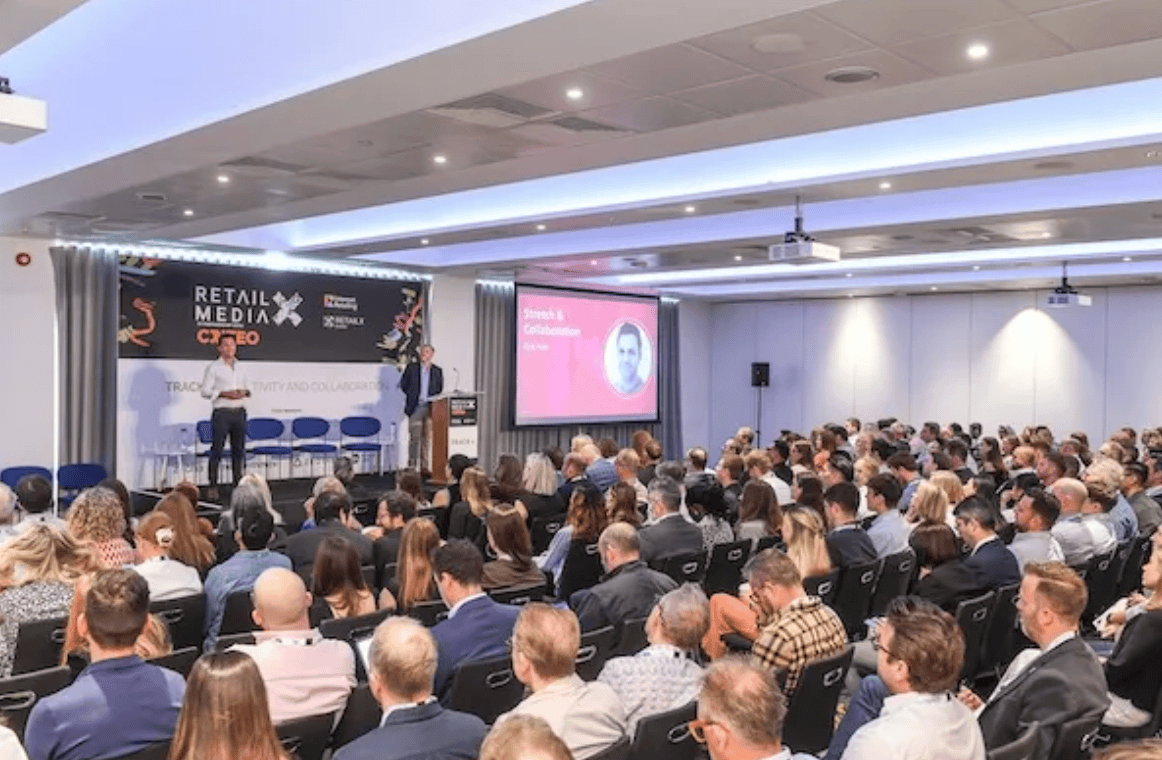


There’s no doubt that retail is at a pivotal point, battered by headwinds from all directions – rising costs, new legislation, disappearing footfall, and rapidly changing markets, to name but a few. Many retailers are looking to technology to provide some, if not all, of the solutions, and it’s against this backdrop that the Retail Technology Show (RTS) will open its doors on 22–23 April at ExCel London. During a special RTS press day, leaders from across fashion, beauty, sport and hospitality offered a snapshot of how rapidly the retail landscape is evolving.
Chaired by Giles Smith, former digital director at Burberry and Selfridges, the panel brought together Meriel Neighbour, global transformation director at River Island; Ana Machado da Silva, VP of digital product at Pentland Brands; Will Lockie, ecommerce director at luxury skincare brand Noble Panacea; Jim Hingston, digital & tech director at Azzurri Group; and Yathu Kanagaratnam, head of technology & AI at Goddiva. Each shared insights on customer expectations, operational pressures and the accelerating pace of technological change – setting the scene for a show that promises to be one of the most forward‑looking yet.
In this context, Meriel Neighbour spoke exclusively to InternetRetailing to provide a clear perspective on digital transformation for a major fashion retailer and why the coming years are critical.
Repositioning River Island for relevance and growth
It’s no secret that River Island has faced significant challenges in recent years, including declining footfall and competition from ultra-fast fashion retailers. The company is now reshaping its business as it enters the next phase of a long-term restructuring programme; this includes streamlining its store portfolio, updating commercial agreements with landlords, and securing new investment to support transformation. Leadership changes are also afoot, with Ben Lewis returning as CEO in 2025, and Antony Smith stepping down as CFO in January.
While technology is essential to River Island’s turnaround, Neighbour stresses the need to establish strong fundamentals first. “River Island has been through a bit of a journey in the last 18 months,” she says. “As much as we want to enable everything through technology, the business needs to understand its sense of direction. We’ve been doing a lot of work to understand our customers, what’s relevant for them, and how we service that. There’s a big strategic move in terms of what that looks like, the impact across all departments in the business, and then how technology can enable it.”
This strategic shift focuses on increasing relevance across more customer occasions – an evolution rather than a rebrand. “We’re not changing the concept of River Island as a mid-range brand at all. What we are doing is identifying more of the occasions our customers want to shop with us for, so we become relevant to those occasions,” she says. “You don’t just come to us for workwear; you’ll come to us for an evening out, for a special event, for your kids when you start to have them, and for your husbands as well. It’s that evolution we’re focused on.”
Unified commerce as the next competitive frontier
A seamless shopping experience across all touchpoints, from app to web to store, is central to River Island’s strategy. “From a customer-journey and technology point of view, we know we have social commerce, an app, a mobile site, a website, and stores, and as we move forward, technology will enable us elsewhere through marketplaces,” Neighbour explains. “We’ve got to make sure that journey is totally connected. I should be able to start my shopping journey, and the technology is there all the way through.”
She points to the seamlessness already visible in parts of the global market. “Start your purchase online on the train, and then as you go past the store what’s in your basket can be picked up there, or you can buy it and have it sitting at your desk by the time you get to work. All of that technology exists, but for River Island we now need to invest to enable that unified journey.”
This investment is underway, with River Island’s turnaround supported by £40 million in new funding from Blue Coast Capital. “Having gone through the changes of the last 18 months, we now have new investment and we’re at the start of our technology journey,” Neighbour says. “It’s probably at least a three-to-five-year end-to-end programme, and we know that as we go through those three to five years, technology will change again. But we’ve started that journey.”
Part of that includes a more agile product model. “That gives us speed to market so we can remain relevant for our customers and deliver freshness, without becoming ultra-fast fashion. We’ll move beyond rigid autumn/winter or spring/summer cycles into a more continuous cycle of freshness.”
Stores still matter – especially with better tech
Although River Island is shuttering many of its stores, Neighbour is clear that physical retail remains crucial. Evolution, however, is essential. “We absolutely believe there is a place for stores in the future. We’re investing in looking at those stores, at the throughput and flow, and upgrading them,” she says.
RFID technology will enhance the in-store experience: “In-store, that means you can go into a changing room and you don’t have to leave it if you need a different size or colour; it can be brought directly to you.”
And for younger customers, shops aren’t just transactional places – they’re experiential. “The new generation shops differently: they want that experience. Some of it we can create through social commerce and influencers online, but the question is how we bring that into the store – how we use technology and service together to create that added‑value, personalised experience.”
AI and virtual try‑on: the next wave
Neighbour sees AI‑driven personalisation and virtual try‑on as major near‑term shifts. “People want added value in the experience,” she says. “Some of it is around technology – virtual try‑on, for example, to reduce the amount of returns. That kind of technology is out there and will become more prolific over the next few years.”
“AI is going to change the way people shop as it comes into the UK from the US over the next six months,” she adds, noting that retailers must invest carefully: “We need to make sure we invest in the right things.”
Stay informed
Our editor carefully curates two newsletters a week filled with up-to-date news, analysis and research. Click here to subscribe to the FREE newsletter sent straight to your inbox. Why not follow us on LinkedIn to receive the latest updates on our research and analysis?