Amazon’s move to trial sponsored product prompts and sponsored brands prompts in the US gives us a window into the next phase of retail media in the AI age.
Announced at the retail giant’s annual unBoxed conference on 11 November, these new AI-powered tools are being offered as a free enhancement to existing campaigns – at least during the beta phase of the trial – and aim to use existing Amazon first-party data from existing details pages, brand stores and campaign data to surface a deeper level of product information across the shopper journey.
Why? According to Amazon, shoppers often struggle to find specific information they need when making purchase decisions. Sponsored Products prompts and Sponsored Brands prompts solve this challenge by functioning as a 24×7 virtual product expert, automatically surfacing relevant details before shoppers even ask questions, says the company.
This enhancement, it claims, will “help accelerate purchase decisions while maintaining brand safety through Amazon’s verified first-party signals and built-in safety parameters”.
Sponsored Products and Sponsored Brands campaigns will be automatically enrolled in prompts without any additional setup required during the trail and Amazon aims to use the beta to learn and perfect, before rolling this out potentially as a paid-for service.
Once reporting dials up, says the retailer, sellers and vendors can review and manage prompts directly in the Ads Console. Within each campaign, brands can navigate to the prompts via Campaign → Ad Group → Ads → Prompts tab, where all prompts are listed if they have received a click. This view displays the prompt text, the associated ad and key performance metrics such as impressions, clicks and orders.
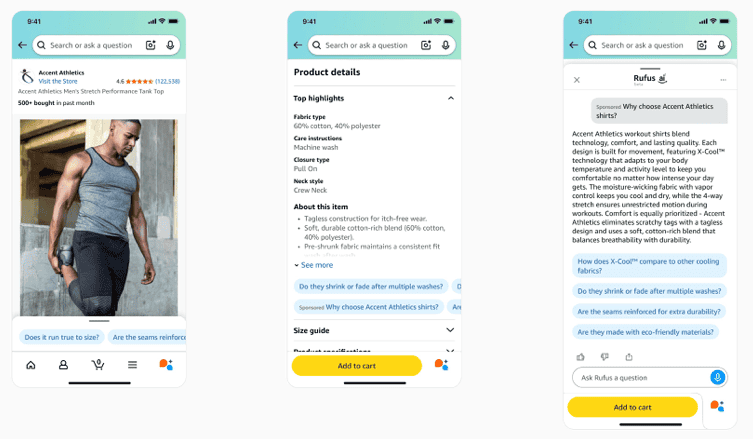
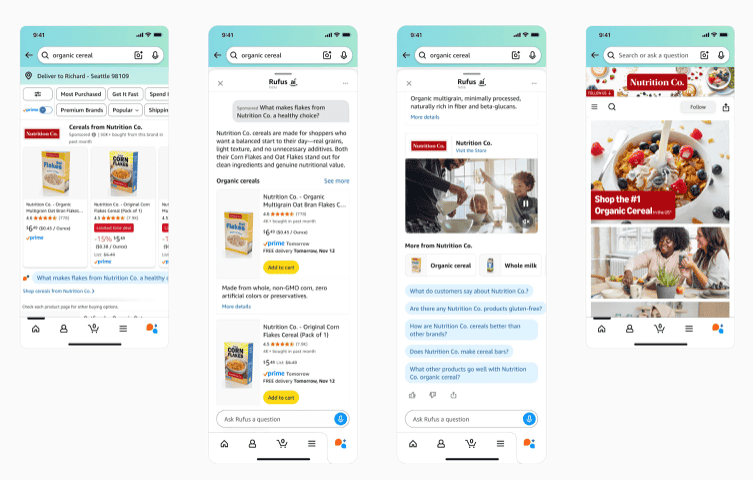
An example: Amazon sponsored prompts (above) and sponsored brand prompts (below)
What does this mean for retail media?
For Amazon, the advantages of AI generated prompts are clear. By automating prompt creation – and with no extra creative load for advertisers – Amazon reduces friction for brands to adopt new ad units. This offers Amazon a way to surface more ad placements/interactions without proportionally increasing advertiser workload. It can mean more ad inventory, more engagement and more monetisation of shopper flows for Amazon.
However, the feature goes beyond simply showing an ad; it tries to insert helpful content such as answers and product details at decision points. This may help reduce bounce or confused shoppers and potentially improve conversion. For brands, it means more ways to differentiate and engage, not just through keyword bids or display placements but through “smart” prompts.
Of course, Amazon has a massive advantage: its own ecommerce data, product detail pages, brand stores, shopper behaviour on its platform. By tying AI prompts to these signals, Amazon can potentially deliver more relevant interactions than off-site ad formats.
For the wider retail-media market, this reinforces the value of owning or having first-party shopping data and being able to activate it in ad formats but it also means that once again Amazon has taken things to the next level while many other retail media networks are still bedding in with yesterday’s next big thing.
If sponsored prompts work to drive sales – especially if it can be proved that they involve limited input from brands and sellers – then many brands may reallocate more budget into Amazon if they believe this new format drives more efficiency or engagement – which can intensify competition and cost for advertisers on Amazon, but may also shift budget away from other channels.
Will other retailers join in? Can they join in? Amazon’s reach and data is so vast that this latest development is, for it, relatively easy to deliver. For other retail media networks less son.
Impact on measurement
There are of course impacts on ad cost, measurement and retail-media maturity that the wider retail media industry will watch with interest. If such prompts drive higher engagement and/or conversion, CPCs – or effective cost per order – could shift; Amazon may use this to refine pricing and auction dynamics.
From a measurement point of view, Amazon providing prompt-level reporting – if indeed it will do such a thing – means more granular insight into conversational ad interactions, which raises the bar for retail media measurement sophistication.
In the broader retail media market, this is another sign of the transition: from simple sponsored search and display ads toward more intelligent, commerce-centric ad experiences. It also underscores that scale and quality of shopping data are becoming decisive in retail-media networks.
Some caveats
However, there are some caveats and things to watch out for. Automated prompts mean less manual control over messaging and brands will want to ensure the prompts align with brand voice – and they may want, nay demand, opt-out or customisation options. Amazon says opt-out controls are accessible, but if this moves beyond a beta, this will be a major concern.
And, while the prompts are automated, brands still need to monitor how they’re performing: are these prompts boosting conversion, are they on-brand, do they shift order value? Again reporting, when live, will be critical and advertisers should test and decide how prompt-driven interactions fit their strategy. However, because this is a very new tool for advertisers, performance data such as lift, conversion impact, incremental versus baseline and so on, is still limited. This is still very much an experiment rather than guaranteed outcome and there is very little to compare it to.
From a creative standpoint, there are other challenges. Brands may need to think about how their product detail pages, brand stores, etc are structured – since the prompts draw from those assets. That means good product content becomes even more valuable.
The overall feeling is that Amazon’s move is an inevitable next step in the march of AI-powered retail media and, as with so many things pioneered by Seattle’s finest, it will become a standard part of any retail media offering. When viewed through the consumer lens – where such prompts offer an enhanced shopping experience that leads to more informed purchases, as well as perhaps greater ad transparency – it is easy to see that this will become an expected part of the shopping journey and so will become an expected part of how retailers leverage the data they have.