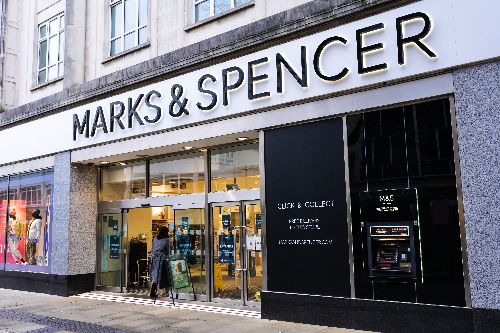
M&S has reported a profit downturn of 23.8% for the financial year ending 28 March 2026 as the fallout from last year’s cyber-attack continues to take effect. Statutory profit before tax was down 28.8% at £364.6m.
Although revenues increased by 24.8% year on year to around £17.4bn, this uplift was largely driven by the consolidation of Ocado Retail into the group accounts. Excluding Ocado, underlying sales growth was a modest 1.9% – indicating that the headline performance overstates the strength of the core M&S business.
“A year of two halves”
M&S describes it as a “year of two halves”, with the cyber-attack causing “significant operational impact” in H1 and a return to sales and profit growth in H2. The M&S cyber-attack, which took place last April and caused severe disruption to supply chains and ecommerce, is estimated to have wiped away one-third of the company’s profits.
Food sales increased by 7% as customer numbers grew, however adjusted operating profit was £444.5m, down from £491.8m in the previous year, due to wastage and stock markdowns caused by the cyber-attack. Fashion, Home & Beauty sales declined 7.7%, again as a result of the temporary pause in online trading and systems access. The Times reports that staff bonuses have been cut this year as the company rebuilds after the attack.
Despite this, CEO Stuart Machin remained bullish about the future of M&S, stating: “Food was our standout performer as more customers than ever chose M&S Food for its quality, innovation, and value. Performance accelerated in the second half, returns were strong, and we continue to outperform the market with the prospect of more growth to come.”
Year for growth
The company has marked out 2026 as a year for growth, investing in supply chain modernisation, technology transformation and store rotation. It plans to double its online fashion business – increasing supply chain capacity to do so – and open new stores, while also embarking on structural cost reduction to offset frontline colleague pay inflation and government tax levies.
“Our job is to protect the magic of M&S while modernising the rest. We’ve now got the momentum to do that at pace. We have a strong culture, a hard-working focused team, and a growth business. There’s an extraordinary opportunity ahead, and we are on it,” Machin said.
The analysts’ view
Investment bank Peel Hunt echoed Machin’s view that M&S is positioned for growth. “The main takeaway for FY26 is the strong balance sheet and stronger 2H for both businesses, moving on from the cyber hit. In FY27, performance is pitched to grow against FY25, a more meaningful comparative. This likely means consensus coalesces c.£925–950m, balancing macro uncertainty with material self-help drivers.”
However, Chris Beauchamp, Chief Market Analyst at investing and trading platform IG, indicated that he expects any gains to be small. “Today’s numbers have been good enough to entice a bounce out the M&S share price, but the justified caution on the outlook means that there is little to provide a real driver for more substantial gains. Like all retailers, this high street icon is now at the mercy of inflationary pressures, and if it can get through the next six months without too heavy a fall in sales then that will be achievement enough.”
Melissa Minkow, Global Director of Retail Strategy & Insights at CI&T, said that the results show the lasting damage a data breach can cause to ecommerce businesses. “Our research found that the majority of consumers say a data breach impacts their shopping behaviours with that retailer, and this year’s M&S results reinforce that. But the fact that M&S Food still delivered sales growth and market share growth demonstrates that the brand’s commitment to innovation in grocery is paying off.
She added: “M&S’s highlighting increased investments in supply chain modernisation, AI-driven decision-making and personalisation through loyalty demonstrates a clear understanding of what it takes to lead the retail charge. The lesson for the wider industry is that getting the fundamentals right – infrastructure, agility, and customer experience – is what determines whether you can maintain momentum when faced with disruption.”
Stay informed
Our editor carefully curates two newsletters a week filled with up-to-date news, analysis and research. Click here to subscribe to the FREE newsletter sent straight to your inbox. Why not follow us on LinkedIn to receive the latest updates on our research and analysis?