Generative AI is making it easier for retailers and brands to produce more advertising, more quickly and in more formats – yet new research suggests that the volume of creative being generated is increasing much faster than its quality.
As retail media networks expand across retailer websites, apps, stores, connected television, social platforms and the wider open web, brands are being asked to provide more variations of creative, tailored to different retail partners, audience segments, channels, placements and points in the customer journey.
AI appears to offer an answer and it can resize assets, rewrite copy, adapt product imagery, produce video variations and personalise campaigns for different audiences at a speed that would previously have been impossible.
However, new research from WARC and LIONS Advisory, conducted in partnership with TikTok, suggests that using AI to increase creative output does not necessarily improve creative effectiveness.
Some 90% of marketers agree that AI has quickly become part of the creative toolkit, while 88% say generative AI has increased the volume of creative they produce. Yet only 45% say it has significantly improved creative quality.
For retailers and brands investing in retail media, the risk is clear. AI could help the industry produce a much larger quantity of advertising without necessarily making that advertising more relevant, persuasive or useful to shoppers.
The strongest creative outcomes, the report argues, are increasingly coming from companies that combine AI with community intelligence: the live signals generated when people search, comment, share, create, review, recommend and buy.
These signals may be particularly valuable in retail media because retailers already sit close to the transaction. Combining commerce data with the cultural and behavioural signals generated by online communities could make retail media creative more responsive to what customers actually want, rather than simply faster to produce.
More creative does not automatically mean better retail media
The rapid growth of retail media has created a creative production problem. A brand may need one version of a campaign for a retailer’s search results, another for product pages, a third for the retailer’s social channels and further adaptations for digital screens, connected television and offsite advertising. Each retailer may also have its own audience definitions, creative specifications and campaign objectives.
Generative AI can reduce the cost and complexity of producing these variations. It can turn a single asset into dozens of executions designed for different retail environments. But if every variation starts with the same weak assumptions, AI merely reproduces those assumptions at scale.
The research finds that demographics remain the most common input when marketers prompt AI, cited by 67% of respondents. This is despite 59% agreeing that traditional demographic segmentation is no longer effective, according to WARC’s Marketer’s Toolkit 2026.
Only 17% of marketers always incorporate community or audience insights beyond demographics into their generative AI workflows.
That gap should concern the retail media industry. Retailers frequently promote the quality of their first-party data and their ability to understand customers through shopping and transaction behaviour. Yet there is a danger that the creative used to reach those customers is still being developed around broad age groups, income bands and household categories.
A supermarket may know that a customer buys plant-based products, shops for a family, responds to promotions and tends to order on a Friday evening. A fashion marketplace may understand which brands, styles and price points a shopper browses. A beauty retailer may see the relationship between content consumption, product research, reviews and purchases.
These are richer signals than age and gender alone. Even so, purchase data does not tell the entire story.
It shows what people have bought, but it may not explain the cultural influences, conversations and emerging behaviours that will shape what they buy next.
Community signals can reveal demand earlier
Most marketers – 86% – say real-time audience behaviour and community signals are important to creative development. The same proportion believes that audience behaviour and community signals will influence creative development more over the next three years.
For retail media, these signals could provide an early indication of changing customer demand. Social and community platforms generate information continuously. Consumers search for products, discuss problems, recommend brands, compare alternatives, post demonstrations, share reviews and remix trends. Creators introduce new products and show existing products being used in unexpected ways.
These behaviours can reveal demand before it becomes fully visible in sales data. A recipe or food trend may begin gaining momentum in creator content before retailers see a meaningful increase in purchases. Discussion around a beauty ingredient, fashion aesthetic, home improvement project or consumer electronics feature may indicate an emerging opportunity before it appears in conventional campaign reporting.
Retailers can already see what customers are searching for on their own websites and apps. Adding broader community intelligence could help them understand why those searches are increasing and how customers are talking about the underlying need.
That could influence more than campaign targeting. It could shape creative messaging, product selection, merchandising, sponsored content and even the way a retail media network packages audiences and opportunities for advertisers.
Marcos Angelides, Managing Director of L’Oréal Lab and Head of AI Operations at Publicis Media, says the advantage comes from the data used to train and inform AI models.
“AI is only as good as the data it’s trained on,” he says. “You’ve got to have behavioural data. You’ve got to know what people actually do, not just what they say they do.”
Retail media is well placed to provide evidence of what people do at the point of shopping. Community platforms can add signals about what they are discussing, discovering and intending to do. The combination potentially creates a more complete picture.
From closed-loop measurement to an intelligence loop
Retail media has largely been built around the promise of closed-loop measurement. A retailer can connect advertising exposure to product discovery, basket activity and sales, giving brands a clearer view of commercial outcomes.
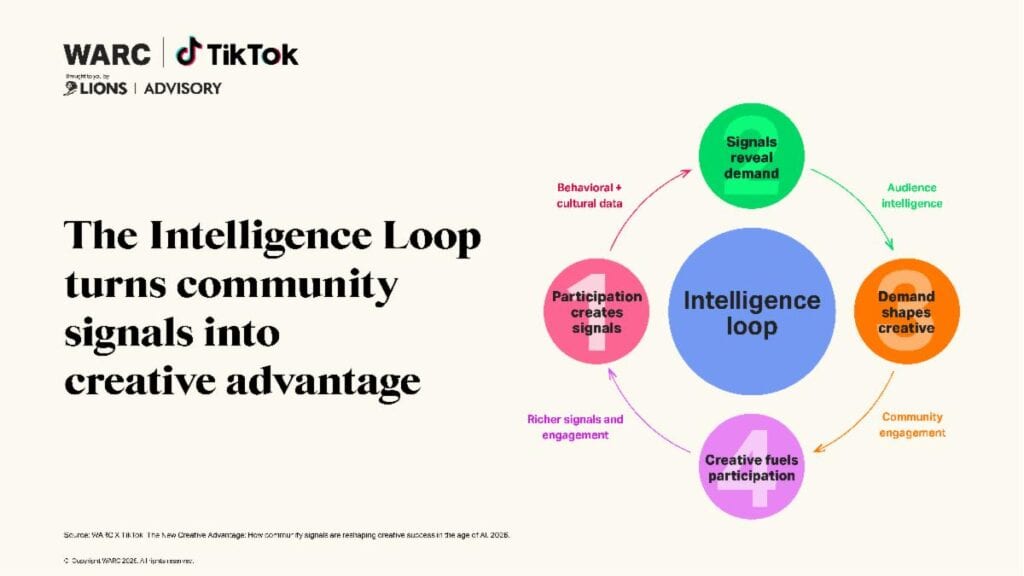
The report introduces a related idea: the “Intelligence Loop”. This is a four-stage cycle in which community participation and AI-powered creative reinforce each other over time.
- First, participation creates signals. Searches, comments, shares, reviews, creator content and transactions generate information about interests, culture and purchase intent.
- Second, those signals reveal demand. They can act as leading indicators of a new customer need or creative opportunity.
- Third, demand shapes the creative. The signals are fed into the AI briefing process, changing the content, offers and messages the system is asked to generate.
- Finally, the resulting creative fuels further participation. Campaigns that resonate generate more engagement, discussion and purchasing activity, creating new signals that improve the next cycle.
This has clear implications for retail media networks. At present, creative production, media activation and measurement are often treated as separate parts of the process. A brand supplies the assets, a retailer or agency activates the campaign, and the results are analysed afterwards.
The Intelligence Loop turns this into a more continuous system. Performance data, shopper behaviour and community response are fed back into campaign development while the activity is still running.
A sponsored product campaign could be adjusted according to the search terms and product concerns emerging from customers. Social and creator content could be adapted to reflect the language consumers are using. In-store screen creative could respond to local demand, seasonal behaviour or community trends. Offsite campaigns could be refined using signals from both retailer data and broader cultural participation.
The real value lies not in optimising a single advertisement but in making the entire retail media system learn more quickly.
Retail media creative must become more useful
Retail media reaches shoppers in environments where they are already considering a purchase. This gives it an advantage over many forms of advertising, but it also creates a higher expectation of relevance.
An advertisement appearing beside a product search should help the customer make a decision. Content on a retailer’s product page should answer a question, demonstrate a benefit or highlight a suitable alternative. In-store media should connect with the mission that brought the customer into the store.
Poorly informed AI creative risks undermining that relevance. If a retailer or brand produces thousands of variations based primarily on static demographics, customers may simply be shown more generic advertisements. The advertising may be personalised in appearance without being genuinely useful.
Community intelligence offers a way to improve the input. Comments, questions, reviews and creator content can reveal the words customers use to describe a problem. They may show which product attributes matter, which claims are distrusted, which use cases are emerging and which barriers prevent a purchase.
Those insights can then inform both the media creative and the commerce experience around it. This could be particularly important as retail media moves further into connected television, social commerce and creator-led environments. In these channels, advertising competes not merely with other promotions but with entertainment, conversation and culture.
The brands that succeed will need to understand how products fit into those conversations rather than simply inserting conventional retail ads into new formats.
Creators can become a source of commerce intelligence
The study also argues that creators should be treated as sources of intelligence, not simply as distribution channels. Retailers and brands have traditionally selected creators according to reach, audience demographics and engagement. AI can potentially make this process more systematic, helping teams identify creators according to community fit, cultural relevance and campaign objectives.
However, the larger opportunity may be to learn from creators before the campaign begins. Creators often understand how communities talk about products, which demonstrations are convincing and what kinds of brand activity feel forced or inauthentic. They can identify emerging concerns and use cases that may not yet appear in formal customer research.
A retailer could use these insights to improve its product content, audience planning and campaign briefs. Brands could adapt their retail media assets according to the questions and behaviours that creators see within their communities.
That does not mean handing the creative process over to algorithms or attempting to automate authenticity. It means recognising that creator activity generates information that can improve retail media decision-making.
Applying S.C.A.L.E. to retail media
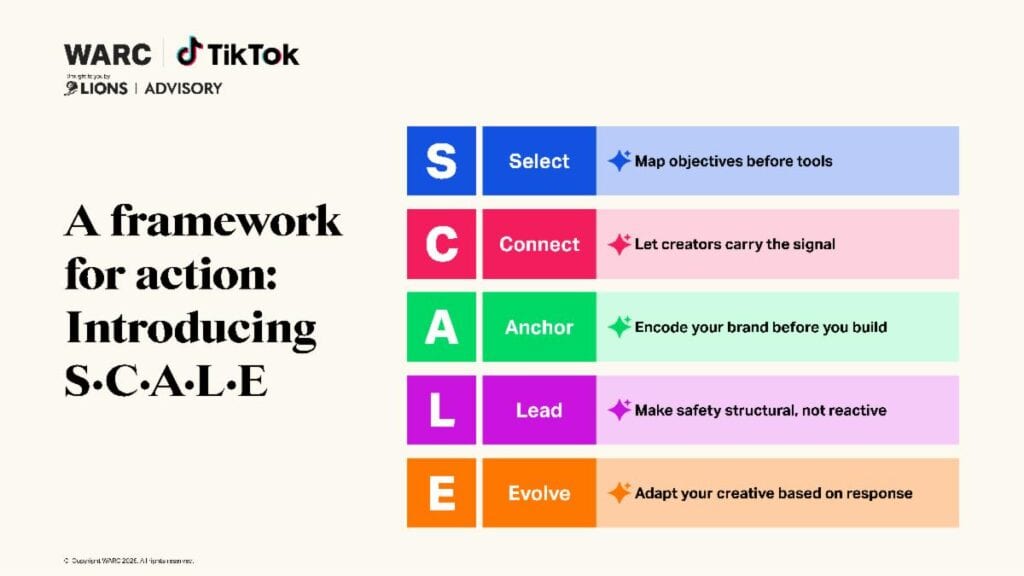
The report introduces the S.C.A.L.E. framework, setting out five principles for using AI and community intelligence more effectively.
Select – Retailers and brands should align their media, audience and commercial objectives before briefing AI. A campaign designed to launch a product requires different signals from one intended to increase basket size, attract new customers or encourage repeat purchasing.
Connect – Creators should be selected and involved according to their relevance to a community and campaign goal, not simply their reach.
Anchor – Brands must input distinctive assets and characteristics into AI systems to prevent campaigns looking like every other advertisement in the category. This is especially important in retail media, where similar products frequently appear beside one another and generic creative can quickly become invisible.
Lead – Companies need clear internal governance around generative AI, transparency and safety. For retail media networks, governance also needs to cover the accuracy of product claims, pricing, promotions, stock availability and sponsored placement. AI-generated creative cannot be allowed to invent product benefits, misrepresent an offer or create inconsistencies between an advertisement and the shopping experience. Retailers will also need to be clear about how community, behavioural and transaction data are used. The value of combining these signals depends on consent, privacy, appropriate aggregation and transparent data practices.
Evolve – Brands and retailers should treat every campaign as a live learning system, using findings from one activation to improve the next. This aligns closely with retail media’s movement towards incrementality and continuous optimisation. Measurement should not be a report delivered after the campaign has finished. It should inform the next creative decision, audience selection and media placement.
The next retail media advantage
Lexi Wolf, Head of Thought Leadership at LIONS Advisory, says the opportunity is not merely to make the existing marketing system faster. “It’s to build a better one: one that helps brands learn from people more continuously, respond with greater speed and relevance, and turn efficiency into effectiveness over time,” she says.
Andy Yang, Global Head of Creative & Brand Ads, TikTok, says: “The brands winning today are not the ones using AI to generate the most content. They are the ones learning the fastest from the people they serve. We call it cultural intelligence, and it is fast becoming advertisers’ most durable competitive advantage.
“Yet the research for this report shows that most brands are briefing powerful AI creative tools with weak inputs: static demographics and legacy assumptions, resulting in creative that scales efficiently but fails to connect. The future belongs to brands that close the loop by creating alongside culture, not behind it.”
For retail media, the message is straightforward. AI can help solve the industry’s growing creative production challenge, but greater output is not the same as greater effectiveness. The quality of retail media will increasingly depend on the signals used to brief, train and refine AI systems.
Retailers possess valuable commerce data. Social platforms and online communities provide live cultural and behavioural intelligence. Creators offer context about how products are understood and discussed.
Bringing these elements together could turn retail media from a system that simply targets known shoppers into one that learns continuously from changing customer behaviour.
The retailers and brands that build that intelligence loop will be able to create media that is more timely, useful and commercially effective. Those that use AI only to produce more creative may find themselves scaling the least valuable part of the process.