Although it’s not actually Christmas for another few weeks, the Christmas ads from many of the UK’s largest retailers are already beaming daily from our TV screens. Most are, unsurprisingly, themed around love, family and community – and while there’s been a lot of discourse around whether the John Lewis ad, featuring Gloria and Pickles the dog, has really hit the mark this year, not to mention that shot of a towel-clad James Norton – the question is: have retailers done enough to close the loop between getting the audience’s attention and converting that into sales?
The rise of retail media means Christmas ads are no longer just a battle for attention. Whereas a few years ago, Christmas ads were largely about brand-building and social media buzz, now they are an opportunity to turn that seasonal goodwill into identifiable customers who can be targeted long after the tinsel and fairy lights have been packed away for another year.
In retail media terms, this year’s slew of Christmas ads divides sharply between campaigns built to feed omnichannel shoppable ecosystems and loyalty data, and pure brand-building spots that largely leave conversion on the table. Let’s take a closer look at some of this year’s biggest campaigns:
John Lewis: Don’t Give Up On Giving
John Lewis has previously been the undisputed king of the Christmas ad, combining powerful storytelling with emotional gravitas, but this year has not hit the mark quite so cleanly. However, despite being criticised by Vanessa Feltz, among others, for its portrayal of an awkward relationship between a grandmother and her “rude and entitled” grandchildren, the John Lewis campaign is, says Kristina Kaganer, co-founder at Auxbow in an article for The Drum, a “perfect 360-degree activation”. Googling ‘John Lewis Christmas ad’ takes you straight to a landing page where you can both watch and shop the advert.
Despite this, the advert itself is more about brand-building than hero products – and considering the aim of the ad is to bring shoppers back in-store for their Christmas shopping, Kaganer points out that John Lewis does little to extend the experientiality of the Christmas ad in its own stores, thus missing a clear omnichannel hook linking in-store experiences, digital touchpoints, and loyalty. “To invest so much in a 360-degree activation and then leave the in-store experience disconnected from the digital journey misses an opportunity to close the loop,” Kaganer says. “And that loop is about more than loyalty.”
InternetRetailing verdict: Biggest missed opportunity
Boots: For Gifts They’ll Really Love
Boots, like John Lewis, has leaned into 360-degree activation, with a landing page that enables viewers to both watch and shop the Christmas advertisement. The advertisement is humorous and playful, based around the idea that (mainly female) recipients of Boots gifts – including Boots No.7 Future Renew Collection and Dyson Airwrap i.d Multi-styler – become obsessed with their gifts long after Christmas has ended.
While there’s a risk that some of the featured products can be shopped elsewhere – meaning Boots could create demand that other retailers convert – its decision to make specific hero SKUs the literal punchline of every scene means that engagement is firmly tied to demand fulfilment.
Alongside the 60-second hero film, Boots launched its first-ever 20-second TVC edits plus a Boots-first Netflix takeover. These short, single-product vignettes translate directly into high-converting paid social, connected TV, and onsite sponsored placements.
And because third-party brands share screen time alongside Boots’ own-brand powerhouse (No7), the campaign gives Boots Media Group a clear commercial hook to sell co-branded digital shelf, Advantage Card targeting, and in-store Star Gift displays around featured lines.
All put together, this makes the Boots Christmas campaign one of the sharpest retail media and shoppable platforms of the season.
InternetRetailing verdict: Best retail media integration
Waitrose: The Perfect Gift 2
Another example of a great 360-degree activation, Waitrose’s Christmas campaign is a sequel to last year’s tongue-in-cheek parody of a Christmas romcom, starring Keira Knightley as herself and Joe Wilkinson as Phil-Phil, the ordinary Joe she falls in love with at the Waitrose deli counter when both ask for Sussex Charmer Mature Cheddar cheese.
Key moments in the advertisement take place in a Waitrose store – such as Knightley running barefoot through the aisles in her wedding dress, gathering ingredients for a cheeseboard – and the landing page for the campaign features recipes for all the hero products shown in the ad, including the cheeseboard and the beef wellington. A series of shorter digital spots features Knightley and Wilkinson falling in love with specific festive products, including Ham & Cheese Croissant Stacks and Pistachio & Sour Cherry Frangipane Mince Pies.
Waitrose has confirmed broad in-store campaign activity alongside its digital rollout, although specific details on live pop-ups or bespoke in-store experiential events have not been publicly detailed in its 2026 launch press releases. The playful but emotional creative is what draws viewers in – the full-length ad is a whopping five minutes long – but the real strength of the campaign lies in its seamless connection between advertising, digital content and in-store retail.
InternetRetailing verdict: Best content-to-commerce journey
Tesco: The Wrong Address
A story about rekindled friendship, the Tesco campaign starring Roisin Conaty and Anna Maxwell Martin focuses on the concept of Tesco showing up for its customers and helping them out when they need it most. This plays well into Tesco’s hugely successful loyalty scheme – which the campaign appears designed to build upon – but its focus on warm storytelling rather than hard SKU placement means it relies on its dominant share of voice and Clubcard scale to capture spend downstream.
Unlike campaigns from Waitrose or M&S that weave hero products directly into the narrative, Tesco’s approach focuses on strengthening the relationship between customer and retailer. That may be less immediately shoppable, but it potentially creates a larger pool of engaged shoppers that Tesco can later monetise through its increasingly sophisticated retail media ecosystem.
In retail media terms, it is effectively using a mass-reach Christmas advert to build first-party audience value, trusting its Clubcard data, media network and scale to do the heavy lifting when it comes to driving conversion.
InternetRetailing verdict: Best first-party data play
M&S: The Home of Christmas
Featuring James Norton as a clean-shaven Santa and Lucy Punch as his wife Mrs Claus, the M&S Christmas campaign unites all the different M&S departments – Food, Fashion, Home, and Beauty – into a single narrative for the first time since 2017. From Lucy Punch’s cotton sateen pyjamas and partywear to party-food “picky bits” like prawn cones, every item seen on screen is shoppable, and can be purchased via the landing page on M&S.
Like Waitrose, M&S ties the film’s food moments directly to its digital hub, festive recipes, and Food-to-Order slots. Once a customer lands on those pages to book a £50 Christmas food deposit or check stock, they are exposed to adjacent sponsored placements and seasonal cross-sells.
The ad has already proved successful for M&S in generating a number of viral moments – including a topless Santa shot – that have generated significant social media and press coverage. That earned media pushes high-intent shoppers straight to M&S.com and the M&S app to search for exact “seen in the ad” outfits and festive food lines.
The campaign also extends in-store, with M&S’s Pantheon store on Oxford Street being transformed to mirror the world of ‘The Home of Christmas’, among other activations.
InternetRetailing verdict: Best omnichannel execution
Lidl: Finding a festive wonderland is More to Value AND Lidl Christmas Everybody
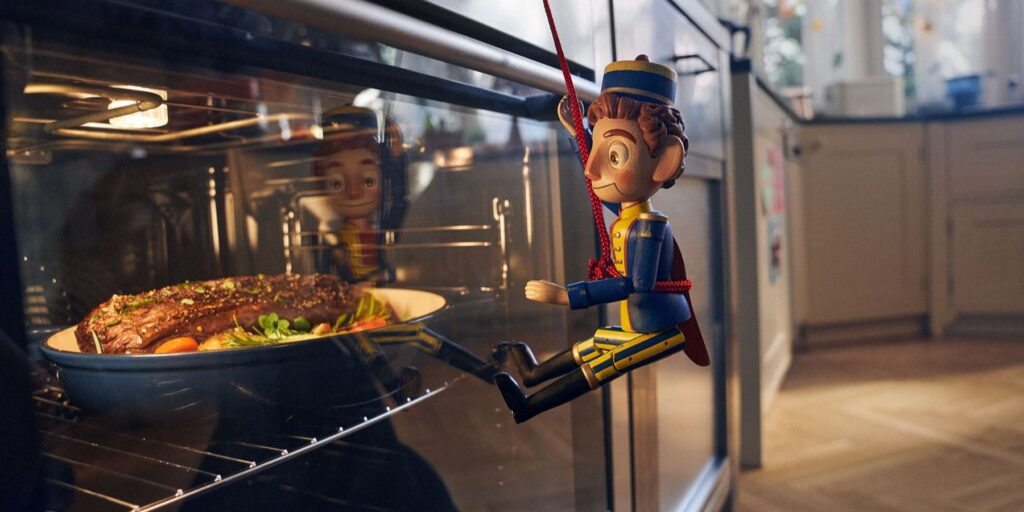
2026 has seen Lidl growing its value and loyalty proposition through Lidl Plus, and its Christmas campaign builds strongly on this. It has created not one but two campaigns: its hero TV advert featuring Nico the Nutcracker, and “Lidl Christmas Everybody”, which features Barry from EastEnders AKA Shaun Williamson singing a Lidl-ised version of the classic Slade song while giving a Lidl Christmas to family and friends including football legend Chris Kamara and Capital Radio presenter Kemi Rodgers.
The latter is across social media only – and leans heavily into the idea of a nostalgic ‘70s and ‘80s-style traditional British Christmas. Although Lidl, as an in-store discount supermarket, has a less mature retail media proposition than some of the other major omnichannel retailers, the dual campaign takes another route. While the Nutcracker TV advert is being rolled out across multiple touchpoints including Lidl’s in-store displays, social media, and Christmas magazine, giving it broad festive reach, the retailer’s highly meme-able Shaun Williamson campaign is about sharing rather than shopping.
The Express has already crowned Lidl’s Shaun Williamson campaign the winner of Christmas ad season – but the interesting question is why. Unlike many of its rivals, Lidl isn’t trying to tug at the heartstrings. Instead, it has produced perhaps the year’s most sharply-targeted and shareable campaign, generating the kind of cultural cut-through that retail media networks increasingly depend upon.
Lidl may not have the direct route from ad to purchase of M&S or Boots, but Lidl Plus gives the retailer its own growing pool of first-party customer data, meaning attention generated through TV and social channels can still be connected to identifiable shoppers and future promotions. In that sense, Lidl is using Christmas less to sell specific products and more to reinforce its position at the centre of the – affordable – festive grocery shop.
InternetRetailing verdict: Best social media cut-through
So, taken together, what do this year’s Christmas adverts tell us, from a retail media perspective? The clear take-home is that the age of the measurable Christmas ad has arrived. Christmas adverts used to be about brand building – but in 2026, the most successful campaigns are doing something more valuable: turning festive storytelling into shoppers, data and revenue.
.