

Colin Lewis takes a deep dive into what marketers and retailers can expect from the coming year – and whether, in the short, medium or long-term, GenAI will become the disruptor that it’s widely expected to be.
Retail media is now established as part of the marketing mix. Retail media expenditure is now almost 29% of all US digital ad spending, according to eMarketer. The pace of innovation in 2025 was incredible: GenAI – where AI assistants shop on behalf of users – is being applied in every area of retail media and agentic commerce. It has gained lots of headlines and podcast time spent assessing how it could impact the retail media industry.
That was then, this is now: what are the trends in retail media in 2026?
Retail media does not live in a bubble: the industry is being influenced by other megatrends that are happening in the world of marketing and media, for example:
- The digitisation of retail surfaces
- The reduced impact of broad reach media like television or print
- The continued impact of video viewed through mobile phones
- The investment in GenAI and the exponential increase in capabilities
- The growth of digital commerce and quick delivery channels.
Where to start? Well, AI of course!
#1 – Agentic AI to continue to make the headlines – but not the sales
AI is now both a ‘layer’ of capability being added to retail media and a ‘lens’ through which propositions are being developed and sold – and agentic commerce is promising to be the biggest layer.
GenAI use cases in retail media are for campaign management, optimisation, and analytics and insights as well as creative and content production.
The bigger potential is seen on the shopper side. Agentic commerce, where AI assistants shop on behalf of users,is promising to alter product discovery for good. The rise of AI shopping agents is already happening. AI agents – embedded in platforms like ChatGPT and Google Gemini – are starting to influence shopper decisions, changing how shoppers discover, consider and buy products online.
Agentic commerce fans say agentic commerce will cause lots of challenge for brands, retailers – and retail media networks – if, as promised, agents become aggregators and product choice collapses into a handful of ranked results surfaced by AI systems that sit outside retailer control.
To see the potential impact of agentic commerce in 2026, do we have a similar, disruptive technology that promised to upend the existing retail model?
Actually we do: the rise of digital commerce back in the late 1990s.
Amazon started out selling books, lots of dot-com startups got lots of VC funding based on grandiose promises of upending everything from pet food sales to airline seats to furniture
We are now a generation into digital commerce. Digital commerce is still only 20% of all retail in the US, around the same in the UK, with only China having a much bigger share. Yes, clearly certain industries have a much larger share of digital commerce, such as health and beauty or travel, but even the promise of direct-to-commerce (DTC) barely made a dent in the total percentages.
Retail is alive and kicking: we still have bookstores. Even mainstream airlines like British Airways are not 100% online sales – not even close.
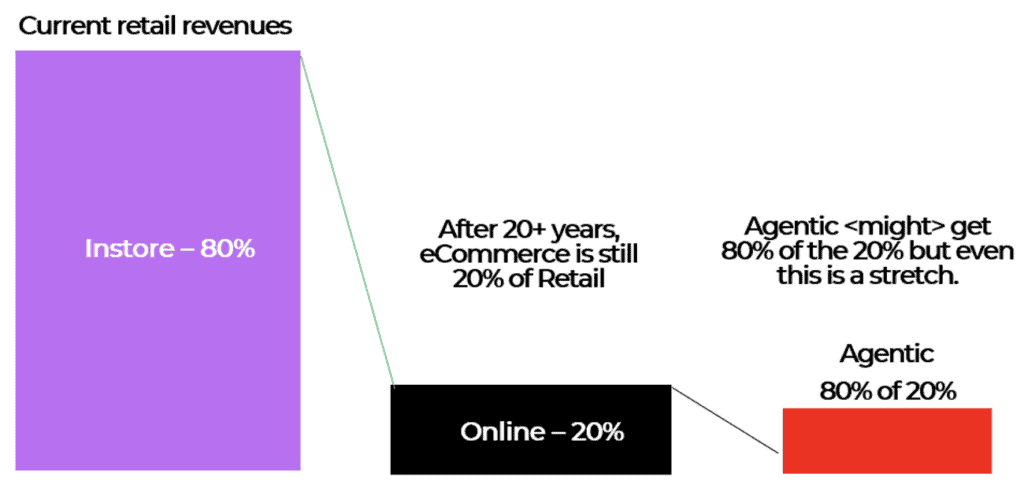
What percentage will agentic commerce get of total retail? If it took a generation and a pandemic to get digital commerce to 20%, there is no chance that agentic commerce will get to 20% of retail in 2026. In fact, it would even be wildly optimistic for agentic to be 80% of that digital commerce 20%.
Let’s address some home truths about agentic commerce:
- New channels are additive, not subtractive. VCRs did not kill cinemas and podcasts have not killed radio stations.
- Infrastructure takes a while to catch up. Pets.com was a disastrous business during the dot.com boom because there was no widespread usage of broadband, payment mechanism from Visa and Mastercard were hard to implement, and fast 5g smart phones were two decades away.
- The reality of the adoption curve: all products go through various stages of adoption, starting with folks who like to try new things and fiddle around – even if they don’t work properly starting out. There is always a much bigger wave when the product is finally accepted by the early and late adopters – and that can take years.
In 2026, lets keep an eye on our shoppers and see if they are really using agentic commerce en masse or will it still remain the remit of the sort of consumer who bought the first iPhone, the first Tesla and the first Google Glasses.
#2 – Video is the language of the internet: retail media must speak the new language
Video is now the ‘language’ of the Internet. Video is reshaping product discovery, impulse buying, and decision-making: video is a ‘Demand Engine’.
The biggest marketing growth lever in 2025 was digital media, driven by TikTok, YouTube and Meta. TikTok has rewritten the rules of content: the impact of short-form video looked at through a mobile phone – triggered by the popularity of TikTok – is changing how people discover products, how they decide what to buy, and how they act on impulse.
The short-form video format enables TikTok’s algorithm to be very dynamic and even capable of tracking changes in users’ preferences and interests across time, going as granular as what a user may like during a certain period of time during the day
TikTok’s early entry into the short-video market also gave the company a big early-mover advantage. The positioning of TikTok as an app built for mobile devices from the beginning also gave it an advantage over rival platforms that had to adapt their interfaces from computer screens.
The mimicking of TikTok’s style, format and algorithm‑driven feeds is felt right across all of social media. Think about Reels, Shorts, Spotlight and how they spread across Facebook, YouTube, LinkedIn, Snapchat, and Instagram.
Meta’s Reels shortform video product now has a $50 billion annual advertising take, run rate, and it just launched a Reels app for TVs last month, suggesting that it has plenty of growth left to come.
Short form video gives us a dopamine hit that creates a new engine of demand, driving instant discovery and sales.
Where does this lead to? A consumer that uses their mobile phone to seamlessly shift between the four ‘S’s of streaming, scrolling, searching, and shopping’ as Boston Consulting Group call it.
What does the growth of short-form video mean for retail media?
In a world of limitless video options found with just a swipe of a scroll, modern audiences are more receptive to content that quickly communicates the message and grabs attention or, in other words, provides instant gratification.
The problem is that most retail media networks (RMNs) operate within a designed for digital display ads, banners, search ads, and static carousels.
Retail media was built to monetise digital and in-store shelf space. The biggest advertising units such as ‘Sponsored Products’ and ‘Sponsored Display’ sit within defined shopper journeys.
The new world of means introduces a different dynamic: discovery-led, video-powered content that is vertical, scrollable and shoppable by default.
Video blurs shopper journeys as shoppers scroll feeds and are being trained to act quickly on stimulus. The content does the work: a product demo, a personal testimonial, or a viral trend can drive a sale. Andy Murray, Executive Chairman of Saatchi and Saatchi X says that ‘retail media compresses the distance between the point of inspiration and the product in your hands.’ Video compresses this distance even further.
Most RMN formats were not designed for this. Static banners and templated formats struggle to convey context, personality, or persuasion.
To ride this trend in 2026, retail media networks and brand using retail media must:
- Think ‘video-first” – how can you introduce short form video advertising for use across mobile and instore?
- Work on having sponsored brand video working for onsite and partner with TikTok, Meta, YouTube for offsite
- Consider how can you price and sell such inventory
- Consider how can you use AI to scale the myriads of different formats required.
#3 – Creators as retail media “inventory”

2025 was the year that the new CEO of Unilever, Fernando Fernandez, talked about a new “influencer-first” strategy. Fernandez promised to work with 20 times the number of influencers it had previously worked with and said that it would spend half of its ad budget on social media, up from 30%.
Unilever described the role of creators and influencers as “marketing activity systems in which others can speak for your brand at scale.” In a recent campaign for Knorr, Unilever worked with 284 dating and cooking creators across 29 markets. As of December 2025, the Unilever CEO said the company was working with “close to 300,000 influencers” around the world.
Where Unilever goes, other brands follow. Business Insider quoted one large consulting firm saying that they had received “an incredible amount of inbound phone calls” from Fortune 500 brands about how they could increase their influencer marketing investment since Unilever’s March announcement.
ASOS, General Mills, SharkNinja, Gap, Allbirds, and Bath & Body Works talked on their most recent quarterly analyst ahout how they plan to increase their influencer marketing budgets
What should retail media networks do?
Creator and influencer marketing remains loosely connected to the retail media ecosystem. There is no standardised way to book influencer campaigns alongside onsite or offsite placements and only a few RMNs are offering influencers as part of their retail redia proposition.
Retail media networks such as Mimeda in Turkey, the retail media network of Migros group (which has over 2600 stores and a huge online business), are already including influencers as part of their propositions to brand advertisers.
Unilever’s high-profile approach to influencer marketing strategies means that the creator market is also maturing more generally. For example, creator-brand partnerships can include ad content that runs across multiple channels, retail media as well as as Meta and TikTok.
To ride this trend in 2026, retail media networks and brand using retail media must:
- Be inspired by what TikTok, Instagram and YouTube have already done by offering a creator marketplace. Think of creator marketplaces or collaborative media buys that combine reach, relevance
- Build a creator roadmap to fit within the existing retail media proposition
- Integrate creators and influencers directly into its planning tools and sales channels. Influence should be treated as inventory, not a separate initiative
- Work on how this new inventory can be measured to show results to brand advertisers
- Embrace the use of GenAI: GenAI creativity is part and parcel of work with creators as they have taken to these new tools much more quickly to make high-quality content much faster and cheaper.
#4 – Instore innovation everywhere
There is a lot of cutting-edge retail media innovation around the world. Yet, if you only read the typical retail media article, you might think that all the innovation comes from the US.
The reality is that there is a ‘continental divide’ between the US and the rest of the world – and this is NOT a criticism!
Retail media is an industry that was built on the back of digital commerce – namely Amazon. So it’s not surprising that much of the conversation about retail media is about online – it does after all provide a wealth of data and insights into exactly what consumers are doing as they progress from browsing to buying.
However, although Amazon is 40% of all digital commerce in the US, it is only about 5% of total retail.
What is the comparison with the rest of the world?
Well, the rest of the world – outside of China – did not have Amazon to contend with (for the most part, so their orientation with respect to retail media comes from that most of the business is still done instore.
Where does innovation in digital retail media occur? The US. Hence why all the retail media initiatives that we see as cutting edge come from the US.
However, we need to ask the following questions:
- Where are the shoppers in the rest of the world? Instore.
- Where is the customer attention? Instore
- Where does innovation for instore media come from? The rest of the world.
As a result, the digitisation of stores radically transforms the opportunity in retail in the rest of the world.
The physical world can now provide data driven, dynamic digital media experiences that digital has delivered for years – but now at store shelves, end caps and checkout aisles
For retailers outside of the US, instore digital allows them to monetise total traffic, not just online traffic like the US.
As a result, much of the real innovation for instore retail media is happening also outside the US. Necessity is the mother of invention: in Europe, LATAM and Australia and New Zealand, store environments reach mass consumer audiences in a high-visibility, attentive environment where purchase intent is high.
Retailers around the world are redesigning stores as broadcast environments where high traffic zones can deliver high reach and quality attention. Screens at entrances and aisles now rival traditional media for creating brand awareness while data and measurement capabilities are catching up to prove sales and brand lift.
The bottom line for retail media: innovation can come from anywhere, not just the US.
#5 – The trend that will never go out of fashion
When we speak of trends, we tend to think of something new that will be interesting or ‘in play’ for a short period of time.
There is one trend that will be around forever, but will take many flavours and shapes as the capabilities will need to change every year.
What is that? The ‘trend’ of being curious and committing to continuous learning.
Technology, creative, measurement, and organisation design all keep shifting, so the capability that matters most is the ability to keep updating how you think and how you work.
This trend is permanent because the pace of change is permanent. Many retailers are ‘laying the tracks down in front of them’. Every stage and every new channel teaches us something new, from technology and operations through to measurement, creative and organisation design.
The only real advantage is curiosity and the discipline to adapt. That means constantly learning, documenting what worked and what did not, and turning results into repeatable approaches.